
Rs 95,840 bonus
Withdraw Rs 100–500,000
1-3 min

Aviator Crash
The famous climbing-multiplier rocket that started the crash craze.
Developer: SkyLogic Games
Where to Play Aviator Crash
Every platform below supports this game — these are the five highest-rated.

b9 game
B9.Game offers a selection of online games, including Aviator, Chicken Road, Pirate Flip, and Squid Gamebler, alongside various Slot, Live, and Sports gaming options.
Rs 64,620 bonus
Withdraw Rs 100–500,000
1~10 min

pk33 game
PK33 is an online entertainment platform operating under registration number PK-GAME-2020-PK33, authorized by the Pakistani authorities. The official website hosts over 17,000 activities
Rs 91,205 bonus
Withdraw Rs 100–500,000
1-15min

y888 games
Y888 is an online gaming platform catering to the Pakistani market across various web domains. The platform features a broad selection of digital casino entertainment, ranging from fast-paced crash games like Aviator and Go Rush to popular slots .
Rs 76,050 bonus
Withdraw Rs 100–500,000
6-15 min

888 game
888game is a Brazilian online casino platform featuring a range of traditional casino games, live dealer options, and exclusive slot titles. The mobile-friendly.
Rs 80,624 bonus
Withdraw Rs 100–500,000
1-15min
How to Play
Aviator is a multiplayer crash game developed by SPRIBE. A plane takes off, a multiplier rises from 1.00×, and the round ends when the plane flies away. The player must cash out before that happens.
That is the entire game. There are no cards to rank, reels to spin or symbols to match. The only active decision is when to leave the round.
Simple rules do not make the result predictable. The crash point is generated before the round begins. A player can choose a smaller target and collect more frequent low returns, or wait for a larger multiplier and accept more failed rounds. Neither choice removes the mathematical house edge.
Aviator at a Glance
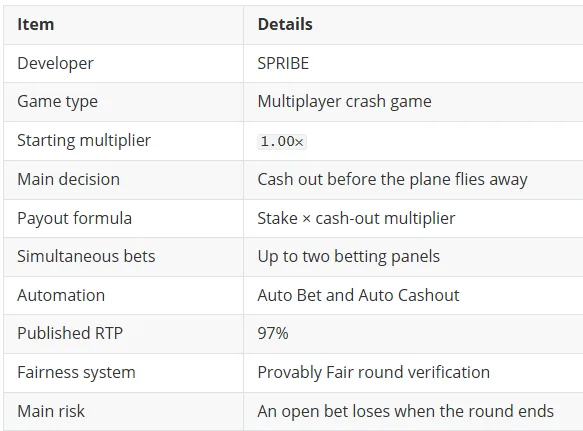
SPRIBE's published rules confirm that the result coefficient is generated before take-off. The game also provides two betting panels, Auto Bet, Auto Cashout, bet history, live bets, chat and a Provably Fair verification option.
The 97% RTP is a long-run mathematical rate. It does not mean that every PKR 100 bet returns PKR 97, and it does not guarantee a specific result during one session. A 97% RTP corresponds to a theoretical 3% house edge over a sufficiently large volume of play.
What Is a Crash Game?
A crash game turns one random result into a rising multiplier.
At the start of an Aviator round, the multiplier is 1.00×. It then climbs on screen: 1.05×, 1.20×, 1.50×, 2.00× and possibly much higher. The round can end at any point.
If a player cashes out before the end, the return is locked at the accepted multiplier. If the round ends first, the active stake is lost.
The moving plane is a visual display of the round. It is not responding to individual players, the number of bets or the value of a particular stake. Pressing Cash Out does not make the plane leave, and another player's large withdrawal does not change the result.
How to Play Aviator Step by Step
1. Open the Game Before the Betting Window Closes
Aviator runs as a continuous series of short rounds. Between rounds, a countdown gives players time to enter a stake and submit a bet.
If the betting window closes before the bet is accepted, the player must wait for the next round. Do not rush a larger stake simply because the countdown is almost finished.
2. Choose the Stake
Enter the amount in the first betting panel. The selected amount is the maximum that can be lost on that panel during the round.
A second panel can be enabled if the player wants to place two separate bets. Each panel has its own stake and cash-out instruction. Two panels create two positions in the same round; they do not create two independent crash results.
3. Press Bet Before Take-off
Once the bet is accepted, the stake is active for the next round. The multiplier starts at 1.00× when the plane takes off.
Some versions show the button changing from Bet to Cash Out. The potential return normally updates as the multiplier rises.
4. Cash Out While the Round Is Active
Press Cash Out before the plane flies away. The request must be accepted while the round is still active. Waiting until the animation appears close to a target does not reserve that target.
The return is calculated as:
**Return = stake × accepted cash-out multiplier**
Examples:
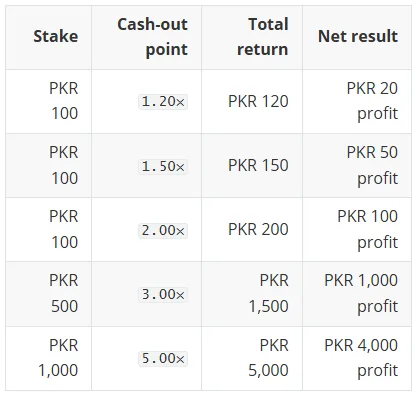
The total return includes the original stake. A PKR 100 return at 1.20× is not PKR 120 profit; the profit is PKR 20.
5. If the Plane Leaves First, the Bet Loses
An active bet has no partial value after the round ends. It does not matter whether the plane missed the player's target by 0.01× or by 50×. No accepted cash-out means no return for that bet.
6. Review the Result
The History or My Bets area shows the round multiplier, stake and cash-out information. SPRIBE's rules also allow the player to open the fairness check beside a completed result.
History is useful for checking settlements and reviewing personal decisions. It is not a prediction chart. Ten low rounds do not force the next round to be high.
Manual Cash Out, Auto Cashout and Auto Bet
These three controls are often confused.
Manual Cash Out
The player watches the multiplier and presses Cash Out during the round. This gives full control but also creates hesitation. A player who planned to leave at 1.50× may wait for 1.60×, then 1.80×, and lose the bet when the round ends.
Auto Cashout
The player enters a target before the round. If the multiplier reaches that value, the game automatically settles the bet.
Auto Cashout does not improve the probability of reaching the target. Its value is execution: it follows the decision made before the pressure of the live round.
Auto Bet
Auto Bet submits a new stake automatically in following rounds. It is separate from Auto Cashout. Turning on Auto Bet without also setting a cash-out rule can create repeated active bets that still require manual action.
Automatic betting makes losses arrive faster when a poor plan is repeated. Use it only with a defined number of rounds, a fixed stake and a stop condition supported by the platform.
How the Two Betting Panels Work
Aviator allows two bets in the same round. The panels can use different stake amounts and different cash-out targets.
For example:
- Panel A: PKR 200 with Auto Cashout at 1.50×
- Panel B: PKR 100 with a manual higher target
If the round reaches 1.50×, Panel A returns PKR 300. That equals the combined PKR 300 placed across both panels. Panel B can then continue without leaving the round's starting money uncovered.
This works because the lower-target stake is twice the higher-risk stake. The general cover calculation is:
**Required cover multiplier = total stake across both panels ÷ stake on the cover panel**
With two equal PKR 100 bets:
**PKR 200 total ÷ PKR 100 cover stake = 2.00×**
So two equal bets need the first panel to reach 2.00× merely to recover the combined starting stake. A 1.50× cash-out on one equal panel returns only PKR 150, leaving the round down PKR 50 if the other panel later loses.
The dual-panel method changes how the result is distributed. It does not hedge the crash itself. If the round ends before the lower target, both bets lose together.
Understanding Multiplier Targets
A cash-out target can be translated into the minimum hit rate needed to break even before considering the house edge.
The simple formula is:
**Break-even hit rate = 1 ÷ target multiplier**
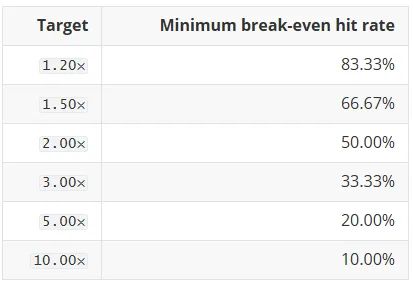
At 2.00×, for example, a player must win at least half of all equal-sized bets just to break even. Because the game has a house edge, the actual long-run result is below the clean break-even line.
Lower targets create more frequent successful cash-outs but smaller gains. Higher targets create fewer successful cash-outs but larger individual returns. Changing the target changes volatility, not the underlying house advantage.
One Round, Fully Explained
Suppose a player has set aside PKR 2,000 as a complete entertainment budget for the session.
The player opens one betting panel, enters PKR 20 and sets Auto Cashout to 1.50×.
Three outcomes are possible:
1. **The round ends before 1.50×.** The PKR 20 stake is lost.
2. **The multiplier reaches 1.50×.** Auto Cashout returns PKR 30, producing PKR 10 profit.
3. **The multiplier continues to 20× after the automatic exit.** The return remains PKR 30. A completed cash-out cannot be reopened just because the round later goes higher.
The third outcome often creates regret. The player sees a high final multiplier and feels that leaving at 1.50× was a mistake. It was not a mistake if 1.50× was the planned target. The decision must be judged using the rule set before the round, not the highest multiplier visible afterwards.
The Player's Real Decision Model
Aviator appears to be a timing game, but the crash result is already generated. The player's actual control is limited to four choices:
1. How much to stake.
2. Which multiplier to target.
3. Whether to use one or two panels.
4. When to end the session.
Everything else is presentation. The rising curve, chat reactions, public withdrawals and previous multipliers create pressure, but they do not reveal the next result.
Good play therefore means controlling exposure and following a pre-set decision. It does not mean reading the plane.
Five Advanced Aviator Tips
Tip 1: Start With the Break-even Rate, Not the Payout Number
A large multiplier looks attractive because the return is easy to imagine. The missing part is how often the target must be reached.
Before choosing a target, calculate 1 ÷ multiplier:
- A 1.25× target needs an 80% hit rate to break even.
- A 2.00× target needs a 50% hit rate.
- A 4.00× target needs a 25% hit rate.
- A 10.00× target needs a 10% hit rate.
The game is designed so that the real long-run rate sits below the break-even requirement after the house edge. No target turns negative expectation into positive expectation.
The calculation is still useful. It shows the cost of chasing a larger number and prevents a player from treating 10× as a routine outcome.
Pick one target for a block of rounds instead of changing it after every result. Constant target changes usually reflect emotion rather than new information.
Tip 2: Size the Stake From a Session Budget
Do not choose the stake from the account balance shown on screen. First decide how much can be lost during the session without affecting bills, savings or borrowed money. That smaller figure is the session budget.
A conservative fixed-unit example is 0.5% to 1% of the session budget per round:
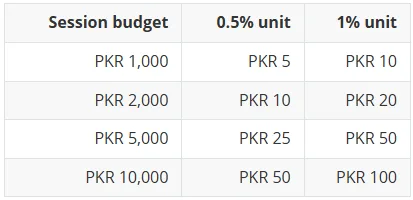
Platform minimums may make the smaller unit unavailable. If the minimum bet is too large for the chosen budget, the correct decision is to use demo mode or not play that table.
Keep the unit fixed. Increasing the next stake after a loss does not make the following round more likely to reach the target.
Tip 3: Use the Dual-Bet Formula Before Opening the Second Panel
The second panel should have a defined job. “One safe bet and one risky bet” is not enough; the stake ratio and cover target must agree.
Use:
**Cover target = (cover stake + high-risk stake) ÷ cover stake**
Example A — equal stakes:
- Cover panel: PKR 100
- High-risk panel: PKR 100
- Required cover target: (100 + 100) ÷ 100 = 2.00×
Example B — cover stake twice as large:
- Cover panel: PKR 200
- High-risk panel: PKR 100
- Required cover target: (200 + 100) ÷ 200 = 1.50×
Example C — cover stake three times as large:
- Cover panel: PKR 300
- High-risk panel: PKR 100
- Required cover target: (300 + 100) ÷ 300 = 1.333…×
Round the target up to a value the interface accepts. Never round down if the purpose is to cover both stakes.
This setup only covers the combined stake when the low target is reached. A crash before that point loses both positions. The second panel therefore increases total exposure even when the plan sounds defensive.
Tip 4: Automate the Exit, Not an Unlimited Chase
Auto Cashout is useful because it removes the live temptation to wait for “just another 0.1”. Set the target before the round and let the instruction execute.
Auto Bet is different. It can submit many wagers in a short period. If it is used, define all four limits first:
1. Fixed stake per round.
2. Fixed cash-out target.
3. Maximum number of rounds.
4. Maximum session loss.
Do not use a progressive setting that raises the bet after a loss. That is Martingale under another name.
SPRIBE's rules state that an interrupted connection during an active bet triggers a cash-out at the current coefficient. Even so, a weak connection is not a strategy. Use Auto Cashout for planned execution and check the My Bets record after any disconnect.
Tip 5: Track Rule-following, Not Streaks
A round log should record decisions, not attempt to find a secret multiplier pattern.
Use five columns:
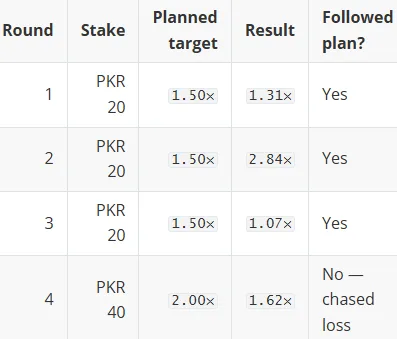
The important information in this example is not the sequence 1.31, 2.84, 1.07, 1.62. Those results do not forecast round five. The useful fact is that the player broke the stake and target rules after round three.
Stop the session when any of these happens:
- The loss limit is reached.
- The planned number of rounds is complete.
- The player increases a stake to recover a loss.
- The player cancels Auto Cashout during the round to chase a higher result.
- The game stops feeling like entertainment.
The log exposes tilt much faster than it exposes anything about the random results.
What Does Not Work in Aviator
Reading Patterns in Previous Multipliers
Rows of red or low multipliers do not make a high multiplier due. Each result is generated separately. The history panel records the past; it does not leak the future.
Doubling After Every Loss
Martingale assumes that a future win will arrive before the stake reaches the table limit or the balance reaches zero. A run of losses makes the required stake grow quickly:
100 → 200 → 400 → 800 → 1,600 → 3,200
After only six losing bets, the sequence has risked PKR 6,300 to pursue one recovery. The next result remains independent.
Copying Other Players' Cash-outs
The live bets panel shows what other players are doing. It does not show what they know, because they do not know the crash point either. Large public wins are visible and memorable; the many failed bets required to produce them are easier to ignore.
Predictor Apps and Telegram Signals
A predictor cannot obtain the unrevealed result from a screenshot or recent history. Apps and channels promising a “90% accurate signal” usually make money from subscriptions, referrals or stolen account details.
Never install a modified APK, share a one-time password or pay an activation fee for an Aviator signal.
Waiting for the Plane Animation
The animation is not a physical aircraft and there is no human reaction test that can beat a pre-generated endpoint. Manual Cash Out is accepted only if the request reaches the game before the round ends. A visually well-timed click can still be too late.
Provably Fair: What It Proves and What It Does Not
Before a round, the system commits to cryptographic information connected to the result. After the round, the relevant data can be checked through the game's Provably Fair panel. The check allows a completed coefficient to be verified against the commitment.
Provably Fair can help answer this question:
**Was the completed result consistent with the cryptographic data committed for the round?**
It does not answer these questions:
- What will the next multiplier be?
- Is a high round due?
- Which cash-out target will win today?
- Can a player overcome the house edge?
Fair randomness can still produce long losing runs. “Fair” does not mean evenly alternating wins and losses.
Common Aviator Mistakes
Confusing Return With Profit
A PKR 500 stake cashed at 2.00× returns PKR 1,000. The profit is PKR 500, not PKR 1,000.
Treating Two Panels as Two Chances
Both panels use the same crash result. If the plane leaves at 1.10× and both targets are higher, both bets lose.
Moving the Target After a Low Round
A previous low result supplies no new information about the next endpoint. Raising the target because the game “owes” a high round is the gambler's fallacy.
Cancelling a Planned Cash-out
The player sets 1.50×, sees the multiplier moving quickly and decides to wait for 3.00×. This is not adapting to information; the screen has revealed nothing about the hidden endpoint.
Playing With Money Already Needed Elsewhere
A stop-loss cannot protect rent, food, debt payments or emergency savings after those funds have entered the game. The session budget must come from money that can be lost completely.
Frequently Asked Questions
How do you win a round of Aviator?
Place a bet before take-off and cash out while the multiplier is still rising. If the plane flies away before the cash-out is accepted, the active bet loses.
How is an Aviator payout calculated?
Multiply the stake by the accepted cash-out multiplier. A PKR 200 stake at 1.75× returns PKR 350, including the original PKR 200 stake.
Can I place two Aviator bets in one round?
Yes. SPRIBE's rules allow two betting panels. Each can use a separate stake and cash-out instruction, but both are exposed to the same round result.
Does Auto Cashout guarantee a win?
No. It executes only if the multiplier reaches the chosen target. If the round ends below that target, the bet loses.
Does a low cash-out target beat the house edge?
No. A low target produces more frequent successful exits but smaller returns. The published RTP and house edge still apply over the long run.
Can previous multipliers predict the next round?
No. The completed-round history does not reveal the next coefficient. Streaks can occur naturally in independent random results.
Is Martingale a good Aviator strategy?
No. Doubling after losses increases the amount at risk without changing the probability of the next result. A losing run can reach the balance or table limit quickly.
What is the safest way to practise Aviator?
Use demo mode with virtual credit. Test the buttons, Auto Cashout and two-panel calculations without risking money. Demo results still cannot be used to predict later real-money rounds.
What should I do if the connection drops?
Check My Bets after reconnecting. SPRIBE's published rules state that an active bet is cashed out at the current coefficient when the internet connection is interrupted, but the settlement record is the final place to confirm what happened.
Are Aviator predictor apps real?
No predictor can derive an unrevealed crash point from recent multipliers. Avoid signal subscriptions, modified APKs and anyone asking for account credentials or one-time passwords.
Final Note
Aviator has one rule that matters: cash out before the round ends. The harder part is accepting what the player cannot control.
The crash point cannot be read from the animation, chat or recent history. A lower target does not remove the house edge, and a second betting panel does not protect a round that ends early. The useful choices are smaller and less dramatic: fix the stake, understand the target's break-even rate, calculate dual bets correctly, automate the planned exit and stop on schedule.
Use the game as paid entertainment, not as an income plan. If the session budget is gone, the session is over.
Winning Strategies
1
Are Aviator predictor apps real?
No predictor can derive an unrevealed crash point from recent multipliers. Avoid signal subscriptions, modified APKs and anyone asking for account credentials or one-time passwords.
2
What should I do if the connection drops?
Check My Bets after reconnecting. SPRIBE's published rules state that an active bet is cashed out at the current coefficient when the internet connection is interrupted, but the settlement record is the final place to confirm what happened.
Aviator Crash FAQ
What is a safe cash-out multiplier in Aviator Crash?
There is no safe multiplier — every round can crash instantly. Statistically, cashing out between 1.5x and 2x balances win rate and profit best.
Is Aviator Crash rigged?
On the platforms we list, crash results come from a provably-fair server seed. Always play on reviewed platforms with published fairness methods.
Can I auto-cash-out in Aviator Crash?
Yes. Set an auto cash-out target before the round starts and the app sells your position automatically at that multiplier.
Similar Games




Player Reviews
No reviews yet
Be the first to review this game.