
Rs 95,840 bonus
Withdraw Rs 100–500,000
1-3 min

chicken road
Play chicken road game for real money — rules, bonus rounds and winning tips for Pakistani players.
Developers: Neon Cards Ltd, InOut Games
Where to Play chicken road
Every platform below supports this game — these are the five highest-rated.

b9 game
B9.Game offers a selection of online games, including Aviator, Chicken Road, Pirate Flip, and Squid Gamebler, alongside various Slot, Live, and Sports gaming options.
Rs 64,620 bonus
Withdraw Rs 100–500,000
1~10 min

pk33 game
PK33 is an online entertainment platform operating under registration number PK-GAME-2020-PK33, authorized by the Pakistani authorities. The official website hosts over 17,000 activities
Rs 91,205 bonus
Withdraw Rs 100–500,000
1-15min

y888 games
Y888 is an online gaming platform catering to the Pakistani market across various web domains. The platform features a broad selection of digital casino entertainment, ranging from fast-paced crash games like Aviator and Go Rush to popular slots .
Rs 76,050 bonus
Withdraw Rs 100–500,000
6-15 min

888 game
888game is a Brazilian online casino platform featuring a range of traditional casino games, live dealer options, and exclusive slot titles. The mobile-friendly.
Rs 80,624 bonus
Withdraw Rs 100–500,000
1-15min
How to Play
# Chicken Road Game: How to Play and Five Advanced Tips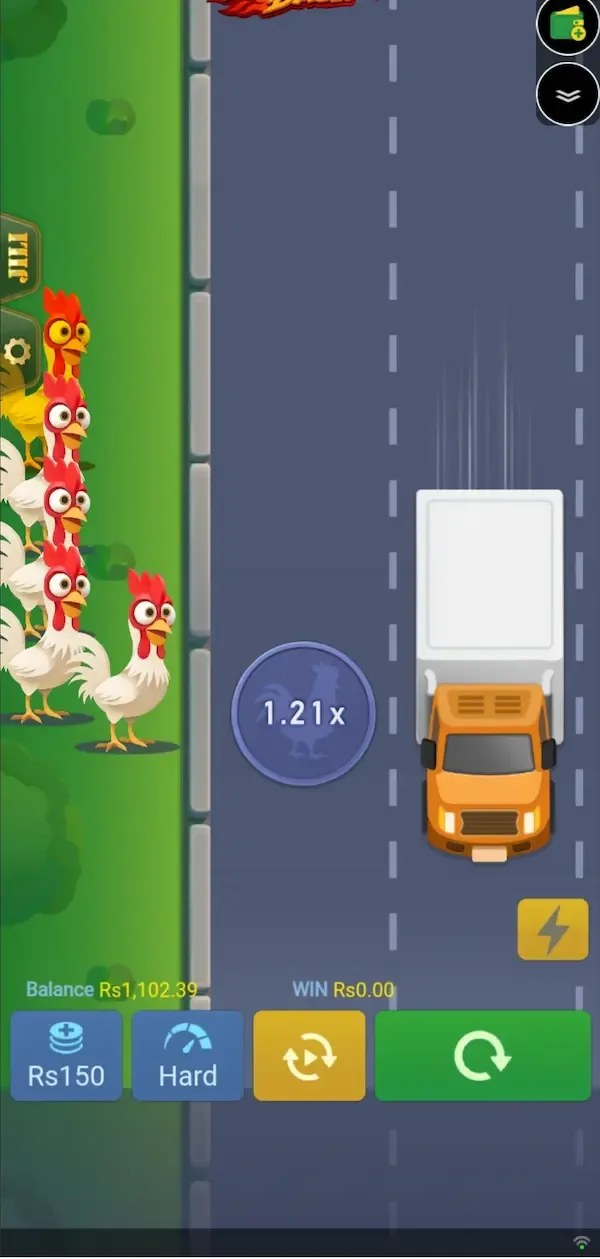
Chicken Road is a step-by-step crash game from InOut Games. A chicken moves along a road one stage at a time. Every safe move raises the multiplier. The player can collect the current value or risk another step. If the chicken hits a losing stage before cash-out, the stake is lost.
The controls are simple, but every extra move changes the balance between return and risk. Easy mode builds the multiplier slowly. Hard and Hardcore raise it faster but end more runs early. The game does not reward quick reactions or pattern reading; the useful decisions are stake size, difficulty, exit point and session length.
This article covers the original Chicken Road released in 2024. It does not describe Chicken Road 2, Chicken Road Bonus, Chicken Road Race or unrelated games using a similar name.
## Chicken Road at a Glance
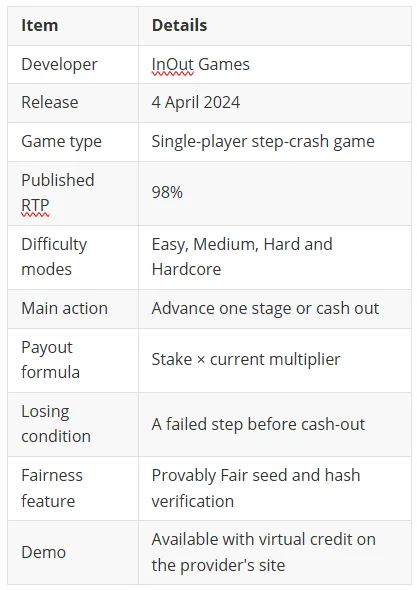
The developer lists a theoretical RTP of 98%. That figure describes long-run game mathematics across a very large number of bets. It does not promise that a PKR 1,000 session will return PKR 980. Short sessions can finish far above or below the published percentage.
A 98% RTP corresponds to a theoretical 2% house edge. No cash-out pattern or difficulty setting removes that edge.
## What Type of Game Is Chicken Road?
Chicken Road combines a crash game's cash-out decision with a stage-based interface.
In a standard crash game, one multiplier rises continuously until the round ends. Chicken Road divides that risk into visible steps. After every safe move, the player has a fresh choice:
- Cash out at the multiplier already reached.
- Move forward and risk the entire active return for a larger multiplier.
Reaching a multiplier does not automatically collect it. The amount remains at risk until the player presses Cash Out or the game settles it under an automatic instruction.
That distinction causes many beginner losses. A player may safely reach 2.00×, continue one more step, and lose both the profit and original stake.
## How to Play Chicken Road Step by Step
### 1. Check That You Opened the Original Game
Look for the InOut Games provider name and the title Chicken Road. The provider now publishes several chicken-themed titles with different RTP figures and features. Do not assume that advice for the original applies to a sequel or bonus edition.
The original is listed at 98% RTP and offers four difficulty modes. Operator-specific currency, minimum stake and maximum payout can vary.
### 2. Choose a Stake
Enter the amount to risk for the round. This full amount can be lost on the first failed move.
If the stake is PKR 100, the round begins with PKR 100 at risk. A higher displayed multiplier does not increase the original stake, but it increases the amount the player gives up by taking another unsuccessful step.
### 3. Select a Difficulty
Choose Easy, Medium, Hard or Hardcore before starting the round.
The mode controls how quickly the multiplier grows and how volatile the run feels. Easy generally provides more stages and smaller increases. Hardcore offers steeper multiplier growth with a much greater chance of an early loss.
Difficulty is not a skill ranking. Selecting Hardcore does not make the player's decisions more accurate. It simply accepts a more aggressive risk curve.
### 4. Start the Round
Press Play to lock the stake. The chicken begins at the edge of the route. The current available return and next multiplier should be visible in the game interface.
### 5. Take One Step
Press the movement control—often labelled Go—to attempt the next stage.
Two outcomes are possible:
1. Safe step: the chicken advances and the displayed multiplier increases.
2. Failed step: the round ends and the active stake is lost.
The player cannot steer around a hidden losing result by tapping at a special time. The crossing animation presents the outcome; it does not turn the game into a reaction test.
### 6. Cash Out or Continue
After a safe step, decide whether to collect or move again.
Pressing Cash Out settles the round at the current multiplier:
Total return = stake × cash-out multiplier
If the player continues, the entire active amount remains exposed to the next step.
### 7. Check the Settlement
After cash-out or failure, review the bet history. Confirm the stake, final stage, multiplier and amount returned.
The Provably Fair section can be used to check a completed result against the game's server seed, client seed and hash information. It verifies past rounds; it does not reveal the next one.
## Chicken Road Payout Examples
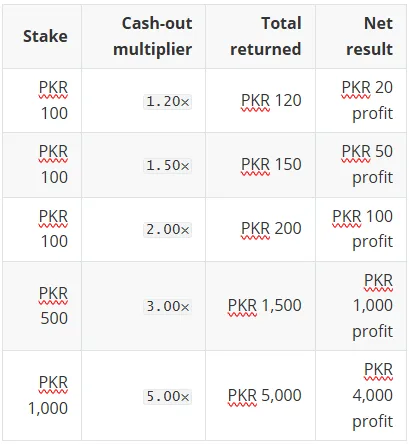
The returned amount includes the original stake. A PKR 500 stake collected at 3.00× produces PKR 1,500 in total, not PKR 1,500 profit.
If the next step fails before cash-out, the return is zero regardless of the multiplier reached one stage earlier.
## What the Four Difficulty Modes Change
### Easy
Easy uses the gentlest risk curve. Multiplier increases are usually smaller, so reaching an impressive return requires more successful steps.
This mode suits interface practice and lower-volatility play. It is not safe in the ordinary meaning of the word. The first move can still lose, and a long sequence of steps can still end before cash-out.
### Medium
Medium raises multipliers more quickly than Easy and exposes the run to a stronger failure rate. It sits between gradual accumulation and large early swings.
Players often mistake the middle label for a balanced winning strategy. It is only a different volatility setting. RTP and random outcomes still govern the result.
### Hard
Hard produces sharper multiplier growth and more failed runs. A small number of successful steps may display a meaningful return, but each decision to continue carries more risk.
Use a smaller fixed stake if moving from Easy or Medium to Hard. Keeping the same stake while increasing volatility changes two risk variables at once.
### Hardcore
Hardcore is the most volatile mode. Multipliers can rise quickly, and runs can end just as quickly.
It should not be treated as a shortcut to profit. A higher possible return is paired with a lower survival rate. The attractive top number is not evidence that reaching it is realistic during a normal session.
## Difficulty Does Not Change the Basic Decision
Every mode asks the same question after a safe step:
Is the extra multiplier worth exposing the current return to one more random result?
The answer depends on the exact multiplier table and survival probability, not on a feeling that the chicken has “momentum”. Higher difficulty makes that trade-off more obvious because both reward and risk rise faster.
Choose the mode before the round. Switching modes after a loss because a harder setting appears able to recover the balance is loss chasing.
## How Multiplier Targets Work
For any planned cash-out multiplier, the minimum success rate needed to break even can be calculated as:
Break-even success rate = 1 ÷ multiplier
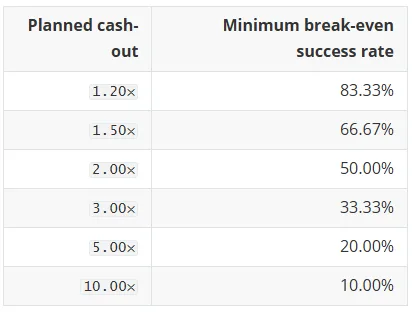
These percentages are mathematical thresholds, not a claim about Chicken Road's actual hit rate at a particular stage. The game table must be used to determine the real stage probabilities. Because the game has a house edge, the long-run relationship is less favourable than a perfect break-even model.
The table is still useful. It shows why a larger multiplier cannot be evaluated by payout size alone.
## A Complete Example Run
Assume a player selects Medium mode and stakes PKR 100.
1. The first move succeeds and shows 1.12×. Cashing out would return PKR 112.
2. The player continues. The second move succeeds and shows 1.29×. Cashing out would return PKR 129.
3. The player continues again. The third move succeeds and shows 1.51×. Cashing out would return PKR 151.
4. The player presses Cash Out. The round closes with PKR 151 returned and PKR 51 net profit.
If the player had attempted the fourth move and failed, the return would have been zero. The previously displayed PKR 151 was available, but it was not secured.
The exact stage multipliers differ by mode and game configuration. The example demonstrates the decision sequence rather than a fixed payout table.
## What the Player Actually Controls
The chicken, traffic, traps and animation make the round look interactive. The player's real control is narrower:
1. The stake.
2. The difficulty mode.
3. The maximum stage or target multiplier.
4. The decision to cash out.
5. The number of rounds played.
The player does not control which step fails. Tapping faster, waiting between moves or copying another player's rhythm does not change the random result.
The strongest practical skill is keeping the five controllable decisions separate from the animation.
Use a Fixed Unit and a Maximum-Round Limit
Set a session budget before opening the game. A small fixed unit—such as 0.5% to 1% of that entertainment budget—slows the effect of a losing run.
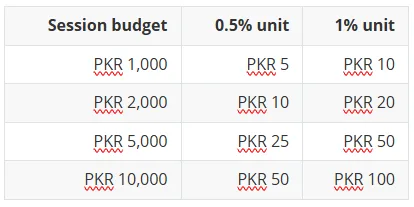
If the operator's minimum stake is larger than the calculated unit, use demo mode or skip the game. The table should fit the budget, not the other way around.
Add a round limit. “Twenty rounds” is clearer than “I will stop when I am ahead.” The latter can extend indefinitely during a losing session.
Do not raise the unit after a failure. A larger next bet has the same random mechanics and a larger financial consequence.
Track Rule-following Instead of Safe-Step Patterns
Keep a short log with six fields:
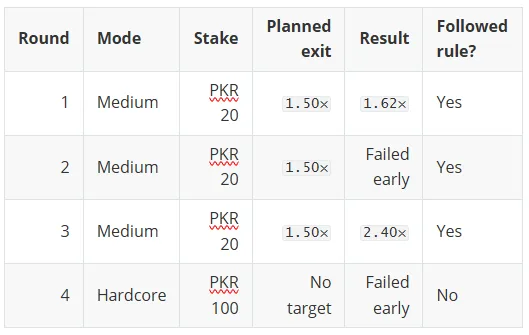
The sequence of safe and failed steps does not reveal the next round. The useful information is that round four broke the mode, stake and target rules after a loss.
Review behaviour, not supposed road patterns:
- Did the stake stay fixed?
- Was the selected mode part of the plan?
- Did cash-out happen at the chosen target?
- Did the session stop at the round or loss limit?
- Was any decision made to recover the previous result?
This is the only record that can improve the next decision without pretending to predict randomness.
## What Does Not Work in Chicken Road
### Memorising Safe Lanes
There is no permanent safe sequence that repeats across rounds. A screenshot from one run cannot map the next one.
### Timing the Tap
The result is not changed by tapping immediately, waiting three seconds or pressing in time with the animation. Delaying a step changes the pace of play, not its probability.
### Increasing the Stake After a Loss
Doubling systems create a rapidly growing sequence:
100 → 200 → 400 → 800 → 1,600 → 3,200
Six failed rounds in that sequence risk PKR 6,300. The seventh round is not more likely to succeed because the first six failed.
### Moving to Hardcore to Recover Faster
Hardcore raises volatility. It does not improve the mathematical expectation or make a recovery more likely. Large multipliers are paired with more frequent early failures.
### Predictor Apps and Signal Groups
An app cannot identify the next losing stage from recent screenshots. “Chicken Road predictor” tools usually sell subscriptions, collect affiliate deposits or request dangerous phone permissions.
Do not install modified APKs, share wallet credentials or pay an agent for a safe-path signal.
## Provably Fair Explained
Chicken Road uses server and client seed information with cryptographic hashing. Before play, the server commits to information connected to the result without revealing it. After the round, the data can be checked against the commitment.
The verification can show that a completed result matches the committed cryptographic data. It cannot show which stage will fail next.
Provably Fair does not mean:
- Every session finishes close to 98% RTP.
- Wins and losses alternate evenly.
- A failed round makes the next one safer.
- The player can calculate the next result from the previous hash.
Random play can produce long losing runs even when the implementation is fair.
## Original Chicken Road Versus Other Versions
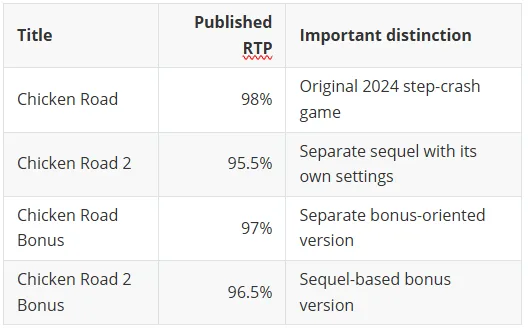
These figures come from the current InOut Games catalogue and can change with later releases. Always read the information panel inside the exact title being played.
## Common Chicken Road Mistakes
### Assuming a Reached Multiplier Is Already Won
The amount becomes final only after cash-out. Taking another step keeps the full active return at risk.
### Confusing Easy With Guaranteed
Easy means lower volatility relative to the other modes. It does not mean the player cannot lose early.
### Using the Same Stake in Every Difficulty
Moving from Easy to Hardcore while keeping a large stake sharply changes session risk. Adjust the stake before increasing volatility.
### Chasing the Highest Number on Screen
The maximum multiplier is designed to be visible and attractive. Its size says nothing about the chance of reaching it during one round.
### Mixing Different Chicken Road Games
The original, sequel and bonus editions have different RTP figures and features. Confirm the provider, title and rules before applying a strategy.
## Frequently Asked Questions
### What is the Chicken Road game?
Chicken Road is a step-based crash game from InOut Games. Every safe move increases the multiplier. The player must cash out before a failed step ends the round.
### Who developed Chicken Road?
The original Chicken Road was developed by InOut Games and released on 4 April 2024.
### What is the Chicken Road RTP?
InOut Games currently lists the original Chicken Road at 98% RTP. This is a theoretical long-run rate, not a guaranteed session return.
### How many difficulty modes are there?
There are four: Easy, Medium, Hard and Hardcore. Higher difficulty generally produces faster multiplier growth and greater volatility.
### How is the payout calculated?
Multiply the stake by the multiplier accepted at cash-out. A PKR 200 stake collected at 2.50× returns PKR 500, including the original stake.
### Does reaching a stage automatically cash out?
No. A safe stage makes the displayed amount available. The player must still cash out instead of attempting another step.
### Is Chicken Road a skill game?
The player chooses stake, difficulty and exit point, but does not control the random step outcome. Risk management affects the size and volatility of results; it does not remove the house edge.
### Is there a guaranteed Chicken Road strategy?
No. Fixed stakes and planned exits can control exposure, but no strategy guarantees that the next step will be safe.
### Can previous rounds predict the next route?
No. Previous safe and failed stages do not provide a map for the next round.
### Can Chicken Road be played for free?
InOut Games provides a demo using virtual credit. It can be used to learn the interface and test exit rules without risking money.
### Is Chicken Road 2 the same game?
No. Chicken Road 2 is a separate sequel with a different published RTP. Check the exact title before relying on rules or figures from another version.
## Final Note
Chicken Road has a clear loop: choose a stake and difficulty, advance through safe stages, then cash out before a failed move ends the run.
The important work happens before Play is pressed. Fix the stake, choose the mode, set the exit and decide how many rounds the session will contain. Once the run starts, a safe move is not a signal to abandon those limits.
Treat the game as entertainment with a known house edge. If the session budget or round limit is reached, stop.
Winning Strategies
1
Treat Difficulty as a Volatility Setting
Do not choose a mode based on confidence, recent wins or the size of a loss that needs to be recovered. Choose it according to the amount of variation the session can tolerate.
2
Set the Exit Before the First Move
A multiplier target chosen after several safe steps is easily influenced by greed. The amount on screen feels partly owned, so one more step begins to look smaller than it is.
3
Separate the Original Stake From the Active Return
After several safe moves, players often think only about the original stake: “It is just a PKR 100 bet.” That understates the next decision.
Similar Games




Player Reviews
No reviews yet
Be the first to review this game.