
Rs 95,840 bonus
Withdraw Rs 100–500,000
1-3 min

Rummy Cards
Arrange 13 cards into valid same-suit sequences and same-rank sets, complete one pure sequence first, and make a correct declaration before the other players.
Developers: JILI Games, 2J Games
Where to Play Rummy Cards
Every platform below supports this game — these are the five highest-rated.

b9 game
B9.Game offers a selection of online games, including Aviator, Chicken Road, Pirate Flip, and Squid Gamebler, alongside various Slot, Live, and Sports gaming options.
Rs 64,620 bonus
Withdraw Rs 100–500,000
1~10 min

pk33 game
PK33 is an online entertainment platform operating under registration number PK-GAME-2020-PK33, authorized by the Pakistani authorities. The official website hosts over 17,000 activities
Rs 91,205 bonus
Withdraw Rs 100–500,000
1-15min

y888 games
Y888 is an online gaming platform catering to the Pakistani market across various web domains. The platform features a broad selection of digital casino entertainment, ranging from fast-paced crash games like Aviator and Go Rush to popular slots .
Rs 76,050 bonus
Withdraw Rs 100–500,000
6-15 min

888 game
888game is a Brazilian online casino platform featuring a range of traditional casino games, live dealer options, and exclusive slot titles. The mobile-friendly.
Rs 80,624 bonus
Withdraw Rs 100–500,000
1-15min
How to Play
What is Rummy Cards? Rummy Cards is JILI Games' online version of classic 13-card Indian Rummy. It is a multiplayer table game, not a slot machine. Each player receives 13 cards and tries to arrange every card into legal groups before the other players. JILI lists the title as a Table and Card game with a 13-card feature. The official page also displays a maximum win of 320x, but this is a game limit, not a promised result.
The goal in one sentence: Make at least two sequences, make sure at least one of them is a pure sequence, arrange all remaining cards into valid sequences or sets, then press Declare before another player does.
Learn the four suits first: A deck has Spades ♠, Hearts ♥, Diamonds ♦ and Clubs ♣. The normal rank order is A, 2, 3, 4, 5, 6, 7, 8, 9, 10, J, Q and K. A sequence must use consecutive cards from only one suit. Cards from different suits cannot be mixed to make a sequence.
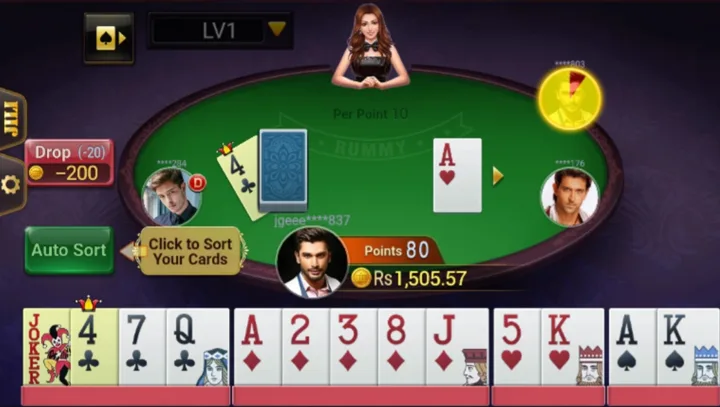
What is a pure sequence? A pure sequence is three or more consecutive cards of the same suit with no Joker replacing a missing card. Examples are 4♥5♥6♥, 8♠9♠10♠J♠ and A♣2♣3♣. This is the most important group because a valid declaration needs at least one pure sequence. If you have 4♥, 5♥ and a Joker acting as 6♥, that group is not pure.
What is the first life? JILI Rummy may call the required pure sequence the First Life or 1st Life. These words simply mean that you have completed one natural same-suit run without using a Joker as a replacement. A beginner should try to complete this group before concentrating on anything else.
What is a second sequence? You also need another sequence, sometimes called the Second Life or 2nd Life. It may be another pure sequence or an impure sequence. For example, 9♦10♦J♦ is pure. The group 9♦, Joker, J♦ is impure because the Joker is standing in for 10♦. Both can work as the second sequence, but only the natural group can satisfy the required First Life.
What is a set? A set contains three or four cards with the same rank but different suits. For example, 7♠ 7♥ 7♦ is a valid set. K♠ K♥ K♦ K♣ is also valid. A group such as 7♠ 7♠ 7♥ is not a valid natural set because the same suit has been repeated. A Joker can usually replace one missing card in a set.
Sequence and set are not the same: 5♠ 6♠ 7♠ is a sequence because the numbers are consecutive and the suit is the same. 5♠ 5♥ 5♦ is a set because the rank is the same and the suits are different. Remember this easy rule: a sequence follows numbers in one suit; a set repeats one number in different suits.
How Jokers work: The printed Joker card can stand in for a missing card in an impure sequence or set. The game also selects a wild rank for the round. If 8 is selected, the 8 cards may work as wild Jokers according to the table rules. Jokers normally carry zero penalty points. Do not use a Joker as a replacement inside the pure sequence that you need for First Life.
Ace rule: An Ace can normally be low in A-2-3 or high in Q-K-A. It cannot turn a corner, so K-A-2 is not a valid sequence. Because online tables can apply a special Joker rule when a printed Joker is selected as the wild card, read the small Rules or Help panel before paying an entry fee.
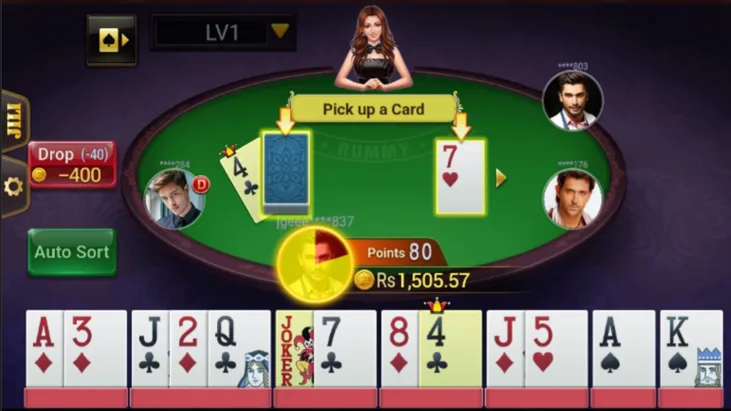
What you see on the mobile screen: Your 13 cards appear at the bottom. The face-down stack is the closed deck. The face-up card beside it is the open or discard pile. Sort or Group arranges cards so that possible sequences are easier to see. Discard removes one card at the end of your turn. Declare or Finish is used only when all 13 cards form a legal hand. A timer shows how long you have to act.
Step 1 — Choose a table carefully: Check the entry amount or point value before joining. The minimum may start near Rs 10 on some Pakistani platforms, but the actual amount is controlled by the operator. Also check the number of players, any service fee, the maximum loss and the maximum payout. Do not assume that the large 320x figure shown on the provider page applies to every table in the same way.
Step 2 — Look at the wild Joker: When the round starts, note which card rank has been chosen as the wild Joker. If the screen marks Q as the wild rank, all Queens may act as Jokers under that round's rules. Keep printed Jokers and wild Jokers easy to see so that you do not accidentally discard them.
Step 3 — Sort the 13 cards: Press Sort if available, then look for two or three consecutive cards of one suit. Keep cards such as 4♥5♥ together because either 3♥ or 6♥ can extend them. Also group same-rank cards such as 9♠9♦. Sorting does not play for you; it only makes the hand easier to understand.
Step 4 — Build the pure sequence first: Search for a natural same-suit run with no replacement Joker. If you already have 6♣7♣8♣, keep it together as First Life. Do not break a completed pure sequence just to chase a bigger-looking set. Without one pure sequence, the declaration will normally be invalid and most or all card points may count against you.
Step 5 — Draw exactly one card: At the start of your turn, take one card from either the closed deck or the open discard pile. The closed deck hides the card until you draw it. The open pile shows what you will receive, but taking that card also tells opponents what type of group you may be building. After drawing, you temporarily hold 14 cards.
Step 6 — Decide which card helps: Compare the new card with your possible sequences and sets. Keep it if it completes or strongly improves a group. If it does not help, it can be discarded. Avoid keeping many isolated cards simply because one future card might connect them.
Step 7 — Discard one card: End the turn by placing one unwanted card on the open pile. Your hand must return from 14 cards to 13 cards. High unmatched cards such as A, K, Q and J are dangerous because each normally carries 10 points if another player declares first. However, do not discard a useful card from a completed sequence without checking the whole hand.
Step 8 — Repeat under the timer: Every turn follows the same simple order: draw one card, rearrange if needed, then discard one card. If the timer reaches zero, the game may discard automatically, skip the turn or remove you according to the table rules. On a weak 3G or 4G connection, tap once and wait instead of repeatedly touching Draw or Discard.
Step 9 — Check all four groups before declaring: A typical 13-card hand may be arranged as 3 + 3 + 3 + 4 cards. First confirm one pure sequence. Then confirm a second sequence, which can be pure or impure. Every remaining card must belong to another valid sequence or set. A loose card outside the groups means the hand is not ready.
Complete winning example: 4♥5♥6♥ is the pure sequence. 7♣8♣ Joker 10♣ is an impure sequence, with the Joker acting as 9♣. K♠K♥K♦ is a set. 2♠3♠4♠5♠ is another pure sequence. These groups contain all 13 cards and include the required pure sequence plus a second sequence.
Step 10 — Make the declaration: After drawing a useful 14th card, discard the extra card into the Finish area if required, arrange the remaining 13 cards correctly and press Declare. The game checks the groups. The first correct declaration wins the round. Do not press the button only because you have a pure sequence; all 13 cards must be valid.
Wrong declaration warning: If one card is in the wrong suit, a set repeats the same suit, a required sequence is missing or a Joker has been used incorrectly, the declaration can fail. A wrong declaration may cause the maximum penalty for that round. Slow down for a final five-second check: pure sequence, second sequence, remaining groups, no loose card.
How points are counted: Number cards 2 to 10 carry their printed value. J, Q, K and A normally carry 10 points each. Printed and wild Jokers normally carry zero. After a correct declaration, the other players' unmatched cards create penalty points. JILI-style rules generally cap one player's penalty at 80 points. The rupee result then depends on the table's point value, entry, commission and operator rules.
Simple point example: Suppose another player declares while your unmatched cards are K♠, 8♥ and 3♦. Their total is 10 + 8 + 3 = 21 points. If the table uses a money-per-point calculation, the platform converts these points under its displayed rate. Do not multiply money in your head until you have checked the exact point value and fee on that table.
Skill matters, but cards still involve uncertainty: You choose which card to draw from the open pile, which card to discard, how to use a Joker and when to declare. These decisions matter. However, you cannot control the shuffled cards or what opponents receive. No strategy guarantees profit, and previous hands do not force the next hand to be better.
Use free demo or practice first: If the platform provides a free demo, learn the buttons without real money. Practise identifying a pure sequence, second sequence, impure sequence and set. Demo credits cannot be withdrawn and demo results do not promise the same result in a paid table.
Android and APK safety: Rummy Cards may open inside a casino website or its main Android app, so a separate Rummy APK is not always needed. Download only from the operator's verified domain or official app page. Avoid APK files sent by unknown WhatsApp numbers, Telegram groups, Facebook comments or pop-up ads. Check the publisher name and requested permissions before installing.
JazzCash and Easypaisa: Deposits and withdrawals are processed by the casino operator, not by JILI's card table itself. Before depositing, check the operator's minimum amount, fee, identity-verification rule, withdrawal limit and processing time. The wallet name and mobile number may need to match the casino account.
Never share secret information: No agent needs your JazzCash or Easypaisa PIN, OTP, app password or phone screen. Keep the deposit receipt and transaction ID. If money does not appear, contact support through the verified website and provide only the transaction reference, not your PIN or OTP.
Bonuses and promo codes: A welcome bonus is not automatically withdrawable cash. It may have a wagering requirement, expiry time, maximum-bet rule or restriction on table games. Rummy may contribute less than slots or may not count at all. Read the bonus terms before accepting it, especially if you plan to withdraw through JazzCash or Easypaisa.
If a withdrawal is delayed: Check whether KYC is complete, the payment number is correct and all bonus wagering has been finished. Review the pending status and contact the platform's official support with the withdrawal ID. Do not send an extra “tax”, “unlock fee” or “release payment” to a private chat contact.
Play as entertainment, not income: Rummy Cards is an adult real-money game when played on a paid table. Use only money left after food, rent, electricity, education, mobile and family expenses. Set a rupee limit and time limit before joining, never borrow to play, and stop rather than increasing the stake to recover a loss.
Winning Strategies
1
Complete the pure sequence before chasing sets
At the start, look for two or three consecutive cards of one suit and protect the easiest natural run. A pure sequence is compulsory, while a set alone cannot make the hand valid. Once First Life is complete, the rest of the hand becomes easier to plan.
2
Discard expensive isolated cards early
An unmatched A, K, Q or J normally costs 10 points if another player declares. If a high card has no close same-suit neighbour and no realistic same-rank pair, consider discarding it before low cards. Do not break a ready pure sequence just to reduce points.
3
Use Jokers for difficult gaps, not the required pure run
Keep the compulsory pure sequence natural. Use a Joker to complete an impure second sequence, a set or a group containing high-value cards. Before declaring, confirm that the group marked as First Life has no Joker substituting for a missing card.
4
Watch the open pile without blindly copying opponents
Notice which ranks and suits opponents pick from the open pile because that can suggest what they need. Avoid feeding an obvious card when another discard is equally safe. This is only partial information; it cannot reveal their full hand or guarantee a win.
5
Check the hand and protect the rupee budget
Before pressing Declare, verify one pure sequence, a second sequence and valid groups for every remaining card. For money play, use one small fixed stake, set a loss limit and stop on time. Never double the next entry to recover a previous loss.
Similar Games
Player Reviews
No reviews yet
Be the first to review this game.