
Rs 95,840 bonus
Withdraw Rs 100–500,000
1-3 min

Teen Patti Gold
The classic three-card showdown that dominates tables across Pakistan.
Developers: Moon Studio, JILI Games, 2J Games
Where to Play Teen Patti Gold
Every platform below supports this game — these are the five highest-rated.

b9 game
B9.Game offers a selection of online games, including Aviator, Chicken Road, Pirate Flip, and Squid Gamebler, alongside various Slot, Live, and Sports gaming options.
Rs 64,620 bonus
Withdraw Rs 100–500,000
1~10 min

pk33 game
PK33 is an online entertainment platform operating under registration number PK-GAME-2020-PK33, authorized by the Pakistani authorities. The official website hosts over 17,000 activities
Rs 91,205 bonus
Withdraw Rs 100–500,000
1-15min

y888 games
Y888 is an online gaming platform catering to the Pakistani market across various web domains. The platform features a broad selection of digital casino entertainment, ranging from fast-paced crash games like Aviator and Go Rush to popular slots .
Rs 76,050 bonus
Withdraw Rs 100–500,000
6-15 min

888 game
888game is a Brazilian online casino platform featuring a range of traditional casino games, live dealer options, and exclusive slot titles. The mobile-friendly.
Rs 80,624 bonus
Withdraw Rs 100–500,000
1-15min
How to Play
Teen Patti Gold Pakistan: Complete Rules, How to Play and Advanced Tips
Teen Patti Gold takes the familiar three-card game and puts it on a live online table. The basic idea is simple: every player receives three cards, chips go into a common pot, and the last player standing—or the player with the best hand at the final comparison—wins that pot.
The decisions are less simple. You can play without looking at your cards, pay more to play after seeing them, fold a weak hand, pressure cautious opponents or ask for a comparison at the right time. That mix of hidden information, rising stakes and short rounds is what gives Teen Patti its tension.
This guide explains Teen Patti Gold for players in Pakistan in plain English. It covers the standard rules, every hand category, Blind and Seen play, Show and Sideshow, common game variations, the way real players think at the table and five advanced tips that are actually useful.
The information was checked on 23 September 2026. Features and event rules can change with app updates, so the rules shown inside a live table always take priority.
Teen Patti Gold at a Glance
| Item | Current information |
|---|---|
| Developer | Moonfrog Labs Private Limited |
| Main game | Teen Patti, also called 3 Patti, Flash or Flush |
| Cards per player | Three |
| Table size | Up to five players in the publisher's current App Store description |
| Platforms | Android and iPhone/iPad |
| Pakistan support | Listed in Pakistan's App Store; Urdu is one of the supported in-game languages |
| Cost | Free to download, with advertisements and optional in-app purchases |
| Currency | Virtual chips and other virtual items |
| Cash withdrawal | Not available |
| Other games in the app | Rummy, Poker, Blackjack, Andar Bahar, Cricket and Chatai, depending on version and region |
| Teen Patti modes promoted by the publisher | Joker, Hukam, Muflis, Royal, AK47 and Pot Blind |
Moonfrog launched Teen Patti Gold in 2014. The developer describes it as one of India's highest-grossing games and says it has more than six million monthly active players around the world. Google Play currently shows more than 100 million downloads. These figures describe the size of the product, not a player's chance of winning.
Most importantly, Teen Patti Gold is a social card game with virtual chips. Moonfrog states that the chips have no real cash value, cannot be exchanged for money or prizes and cannot be withdrawn. Buying a chip pack does not turn the game into a cash-earning app.
Is Teen Patti Gold Available in Pakistan?
Teen Patti Gold has a Pakistan App Store listing and supports Urdu as well as English, Hindi, Gujarati, Marathi, Telugu and Bangla. The publisher also advertises private tables, friend invitations, chat, gifts and play on slower mobile connections.
Availability, payment methods and individual features can differ by device, app-store account and location. Download the app from its official Google Play or Apple App Store listing. Avoid modified APK files, “unlimited chip” tools and links sent by strangers. Moonfrog's rules prohibit bots, scripts, hacks, chip farming, multiple-account abuse and purchases from unauthorised sellers. Such shortcuts can expose the account to theft or a permanent ban.
Is Teen Patti Gold a Real-Money Game?
No. Teen Patti Gold does not offer a cash-out feature. The chips used at the table are virtual entertainment items. A player may earn chips through play, advertisements, challenges, leagues, Lucky Cards or other promotions, and may also be offered the option to buy them. They still cannot be converted into Pakistani rupees or any other real currency.
This distinction is easy to miss because the app uses familiar betting words such as boot, pot, stake and chips. Those words describe how a round works. They do not mean that the winner can withdraw the pot as cash.
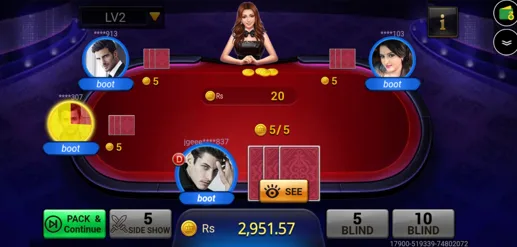
What Is Teen Patti?
Teen Patti literally means “three cards”. It is a comparing-card game played with a standard 52-card deck. In the classic version there are no printed jokers. Every active player receives three face-down cards.
There are two ways to win a round:
1. Every other player folds, leaving you as the only active player.
2. The remaining hands are compared and your three-card hand ranks highest.
This means the strongest cards do not win every pot. A weak hand can win if its owner convinces everyone else to fold. A very strong hand can also earn little if the player frightens the table too early and nobody continues.
Teen Patti Gold Hand Rankings
The standard hand order is the first thing every new player should learn. From strongest to weakest, it is:
1. Trail or Trio
2. Pure Sequence
3. Sequence
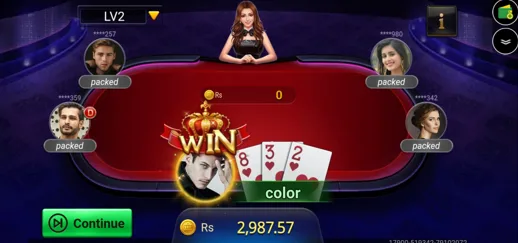
4. Colour
5. Pair
6. High Card
Always compare the hand category first. A low Sequence beats the highest Colour because Sequence is the stronger category. An ordinary Pair beats any High Card, even when the High Card contains an Ace.
1. Trail or Trio
A Trail contains three cards of the same rank.
Examples:
- A♠ A♥ A♦
- K♣ K♦ K♥
- 7♠ 7♥ 7♣
When two Trails are compared, the higher rank wins. Three Aces are the strongest standard hand; three Twos are the lowest Trail.
2. Pure Sequence
A Pure Sequence contains three consecutive cards of the same suit. It is also called a straight flush or pure run.
Examples:
- Q♠ K♠ A♠
- 8♥ 9♥ 10♥
- 3♦ 4♦ 5♦
All three conditions matter: there must be three cards, their ranks must be consecutive, and the suit must match.
3. Sequence
A Sequence contains three consecutive ranks, but the cards are not all of the same suit.
Examples:
- Q♠ K♥ A♦
- 7♣ 8♣ 9♥
- 2♠ 3♦ 4♥
A mixed-suit Sequence loses to every Pure Sequence but beats every Colour, Pair and High Card.
A-2-3 Versus A-K-Q: Check the Table
Teen Patti does not have one universal convention for these two Ace sequences. Some recognised rules rank A-2-3 above A-K-Q. Other tables put A-K-Q first and A-2-3 second. Moonfrog's public store description confirms that Pure Sequence ranks above Sequence, but it does not publish one A-2-3-versus-A-K-Q rule for every current Teen Patti Gold table.
Open the information or rules panel for the room before playing. Do the same on a private table and agree on the order with friends. A-K-2 is normally not a valid Sequence because the Ace cannot wrap around from King to Two.
4. Colour
A Colour contains three cards of the same suit that are not consecutive.
Examples:
- A♣ J♣ 7♣
- K♥ 9♥ 4♥
- 10♦ 6♦ 2♦
If two players have a Colour, compare their highest cards. If those are equal, compare the second-highest cards, then the third. Suits normally have no ranking of their own: Spades do not automatically beat Hearts, and Clubs do not automatically beat Diamonds.
5. Pair
A Pair contains two cards of the same rank and one unmatched card, often called the kicker.
Examples:
- A♠ A♦ K♣
- 10♥ 10♣ 4♦
- 2♠ 2♥ 3♣
Compare the paired rank first. A Pair of Queens beats a Pair of Nines. If both players have the same paired rank, compare the kicker.
6. High Card
A High Card hand has no Trail, Pure Sequence, Sequence, Colour or Pair.
Examples:
- A♠ J♥ 8♦
- K♣ 10♦ 6♥
- 9♠ 5♥ 2♣
Compare the highest card first, then the second and third cards if required. A-K-J in mixed suits is a very strong High Card, but it still loses to the smallest Pair.
How Rare Is Each Teen Patti Hand?
A standard 52-card deck can produce 22,100 different three-card combinations. The table below assumes Classic Teen Patti with no jokers and 12 accepted three-rank runs. It does not apply to Joker, Hukam or AK47 tables.
| Hand | Number of combinations | Chance of being dealt |
|---|---:|---:|
| Trail | 52 | 0.2353% |
| Pure Sequence | 48 | 0.2172% |
| Sequence | 720 | 3.2579% |
| Colour | 1,096 | 4.9593% |
| Pair | 3,744 | 16.9412% |
| High Card | 16,440 | 74.3891% |
Nearly three hands out of four are High Card hands. A Pair appears roughly once in every six deals, while Trails and Pure Sequences are extremely rare.
These are long-run frequencies, not a timetable. Failing to receive a Trail in 400 hands does not make one “due” on the next deal. Each properly shuffled deal starts again with the same probabilities.
How to Play Teen Patti Gold Step by Step
Step 1: Choose a Table
Tables are usually separated by their boot value or entry level. A larger boot makes the pot grow faster. Choose a table whose ordinary swings will not wipe out most of your chip balance in one short session.
Before joining, check the mode name. Classic, Joker, Muflis and AK47 are not interchangeable. Also check any displayed pot limit, minimum balance, event condition or special reward rule.
Step 2: Pay the Boot
The boot is the compulsory starting contribution. Every participating player places it into the pot before the cards are dealt. It gives the round something to compete for and discourages players from folding every hand without cost.
If four players each pay a boot of 1,000 chips, the pot starts at 4,000 chips.
Step 3: Receive Three Cards
Each player receives three face-down cards. At first, you can leave them unseen and play Blind, or view them and become a Seen player. The exact buttons and timing can change by mode, but looking at the cards normally changes the price of future actions.
Step 4: Act in Turn
Play moves around the table. On your turn, the normal choices are:
- Continue Blind without seeing your cards.
- View the cards and continue as Seen.
- Place the required Chaal to stay in the round.
- Pack, which means fold and leave the current round.
- Request a Sideshow when the conditions are met.
- Request a Show when only two players remain and the room allows it.
The app calculates the legal amount and displays the available buttons. Do not assume that a stake rule from a home game applies to every online variation.
Step 5: Continue Until the Round Ends
The pot grows as active players contribute. The round ends when one player remains after all others Pack, or when the final eligible hands are compared. The winner receives the virtual chip pot.
Blind and Seen Explained
The Blind/Seen choice is the central feature of Teen Patti.
Playing Blind
A Blind player has not looked at the three cards. Blind play usually costs less per action than Seen play. It also creates uncertainty for opponents: they cannot tell whether the Blind player is unknowingly holding a Trail or a poor High Card.
Blind play is not automatically brave or clever. It is a deliberate decision to accept less information in exchange for a lower current price and a less readable range.
Playing Seen
A Seen player has looked at the cards. The information is valuable, but continuing usually costs more than it costs a Blind player. Traditional Teen Patti commonly makes a Seen contribution twice the comparable Blind amount, though a live app table may present its own fixed choices or limits.
Once you have seen the cards, you normally remain Seen for the rest of that hand. You cannot erase the information and return to the cheaper Blind status.
When Should You Look?
There is no rule saying that you should always look immediately or stay Blind for a fixed number of turns. Base the choice on four things:
- How many opponents are still active.
- How quickly the required contribution is rising.
- How large the pot is relative to your chip balance.
- Whether you need information now to avoid an expensive mistake.
Staying Blind while the price is small can preserve flexibility. Looking becomes more useful when the next decision is expensive enough that guessing would be wasteful.
Chaal, Pack, Sideshow and Show
Chaal
Chaal is the contribution made by a Seen player to remain active. Players sometimes use the word more loosely for the act of continuing, but in the interface it normally refers to Seen play.
Pack
Pack means fold. You leave the current hand and lose the chips already placed in the pot. Those chips are gone whether you Pack now or continue and lose later.
That last sentence matters. A good decision looks only at the cost from this moment onward. Continuing simply because “I have already put in so much” is the sunk-cost mistake.
Sideshow
A Sideshow is a private comparison between two eligible Seen players while more than two players remain. In the common rule:
- You must be Seen.
- The player immediately before you must also be Seen.
- You pay the required amount and request the Sideshow.
- The other player may accept or refuse.
- If accepted, the two hands are compared privately and the weaker player Packs.
Blind players are normally not eligible. Cost, tie handling and availability vary, so follow the live table prompt.
Show
A Show is the final comparison when only two active players remain. The hands are revealed or evaluated and the stronger hand wins. The amount required to call a Show can depend on whether the players are Blind or Seen.
Traditional rules may award an exactly tied comparison against the player who requested the Show. Apps can implement ties differently. Never invent a suit ranking to break a tie; use the result shown by the table.
A Complete Example Round
Suppose Ali, Bilal, Hamza and Saad join a Classic table with a 1,000-chip boot.
1. All four players pay the boot. The starting pot is 4,000.
2. Each receives three face-down cards.
3. Ali stays Blind and contributes the displayed Blind amount.
4. Bilal looks at his cards. He has A♣ A♦ 6♥, a Pair of Aces, and continues Seen.
5. Hamza looks and sees K♠ 9♠ 4♠, a King-high Colour. He continues.
6. Saad stays Blind for one turn.
7. Ali later Packs when the required amount rises sharply.
8. Bilal and Hamza are both Seen. Hamza requests a Sideshow from Bilal.
9. If Bilal accepts, the hands are compared privately. Hamza's Colour beats Bilal's Pair, so Bilal must Pack.
10. Saad is now the other active player. If Saad also Packs, Hamza wins without showing his cards to the table. If the game reaches an eligible Show, Hamza's Colour is compared with Saad's actual hand.
The example shows why card rank is only part of the game. Bilal has an excellent Pair, but Hamza holds a higher category. Saad has no information about his own cards while Blind, yet his uncertainty also prevents Hamza from assigning him a narrow range.
Teen Patti Gold Game Variations
Moonfrog's store listings promote Joker, Hukam, Muflis, Royal, AK47 and Pot Blind. Mode availability can change by region, season or app version.
Classic Teen Patti
Classic uses the six standard categories and the normal Blind/Seen structure. It is the right place to learn because there are no wild cards or reversed rankings to remember.
Joker
Joker introduces wild cards. A common implementation reveals a card and makes the other cards of that rank wild, but Joker modes are not identical across all apps or events. A wild card can usually stand in for the rank and suit that creates the strongest legal hand.
If Eights are wild and you hold K♠ K♥ 8♦, the Eight may complete a Trail of Kings. If you hold 9♣ 10♣ 8♦, it may become J♣ and complete a Pure Sequence.
Strong categories appear more often in Joker games. Do not value an ordinary Pair or Colour as highly as you would in Classic.
Hukam
Hukam uses a trump-like or revealed-card mechanic to define wild cards. Depending on the implementation, the important property may be the revealed rank, its suit or another displayed condition. Read the table's Hukam panel before the first hand. The mode name alone is not enough to calculate your hand correctly.
Muflis
Muflis is the low-hand version of Teen Patti. The weaker hand wins. Under a common full-reversal rule, the winning preference by category becomes:
1. High Card
2. Pair
3. Colour
4. Sequence
5. Pure Sequence
6. Trail
Within the same category, the lower ranks are also normally preferred. That list describes the general idea, not a guarantee about every tie or Ace rule. Check whether the table fully reverses all categories and how it treats A-2-3. A hand that is excellent in Classic can be terrible in Muflis.
AK47
In the common AK47 format, every Ace, King, Four and Seven acts as a joker. That creates as many as 16 wild cards in the deck. Strong completed hands become much more common, so a natural Pair is much less secure than it would be at a Classic table.
Check that the live rules use all four named ranks as wild cards. Event versions can add restrictions.
Pot Blind
Pot Blind normally keeps all players Blind until a specified pot condition or forced reveal. Unlike ordinary Classic play, you may not be allowed to look at the cards whenever you choose. The pot limit, folding options and final comparison rules must be checked in the room.
Royal
Royal is listed by Moonfrog as a Teen Patti Gold variation, but its public store description does not provide a complete universal rule sheet. Do not guess from the word “Royal”. Open the mode instructions and confirm the eligible cards, hand order, wild-card rule and tie procedure before entering.
Deluxe Tables
The publisher's Pakistan App Store description also mentions Deluxe Tables with a four-times boot. That changes the speed of chip movement, not necessarily the hand hierarchy. A larger opening amount makes table selection and session limits more important.
Other Features Inside Teen Patti Gold
Teen Patti Gold is now a wider card-game hub, not only a single Classic Teen Patti table. Depending on the current build, players may see:
- Rummy
- Texas Hold'em Poker
- Blackjack
- Andar Bahar
- Cricket-themed play
- Chatai
- Private rooms
- Daily and weekly challenges
- Leagues and leaderboards
- Tournaments
- VIP features
- Lucky Cards
- Chat, gifts, frames and emojis
- Seasonal passes and limited-time events
Do not carry Teen Patti rules into these other games. Rummy scoring, Hold'em community cards and Blackjack dealer rules are separate systems.
How Players Actually Think at a Teen Patti Table
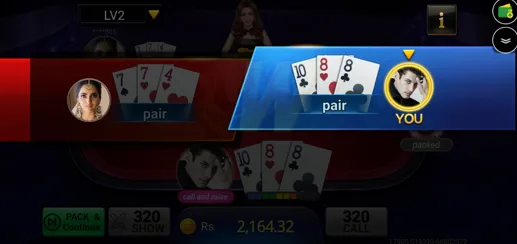
A beginner often thinks about one thing: “Are my cards good?” An experienced player builds a wider picture. The most useful mental model has four parts.
1. Absolute Hand Strength
This is the category printed by your cards: Pair, Colour, Sequence and so on. It answers, “What do I hold?” It does not answer, “How likely am I to win against this field?”
2. Relative Hand Strength
The same Pair changes value with the number of opponents. Against one random hand, a Pair is often strong. Against four players who have all continued through expensive action, the chance that at least one holds something better is much higher.
Relative strength asks:
- How many players remain?
- Are they Blind or Seen?
- Who has willingly paid the higher price?
- Has anyone requested or refused a Sideshow?
3. Price and Chip Survival
The pot may be attractive, but the next action still has a cost. A player should compare that cost with the pot, the likely chance of winning and the possibility of further contributions.
Chip survival matters because losing most of a balance removes future choices. A player with a healthy stack can wait for a suitable table and leave a bad situation. A player who risks everything on one uncertain hand has no such flexibility.
4. Opponent Behaviour
Every action provides imperfect information. A normally cautious player who suddenly pays a large Seen amount is different from a player who attacks almost every pot. The bet itself means little without that person's baseline.
Useful observations include:
- How often the player stays Blind.
- How quickly the player looks at the cards.
- Whether large bets appear only after looking.
- How often the player Packs after resistance.xd
- Whether the player changes behaviour after a loss.
- Whether a refused Sideshow is normal for that player or unusual.
One action is a clue, not proof. Build a pattern over several rounds.
The Three Loops That Keep Players Engaged
Understanding the game's design also helps a player stay in control.
The Hand Loop
Receive cards, choose Blind or Seen, contribute, react to opponents and see the result. It lasts only a short time, which makes another hand feel easy to start.
The Session Loop
The player watches the chip balance rise and fall, changes tables, completes challenges and tries to recover from losses. This is where frustration and overconfidence begin to influence decisions.
The Progression Loop
Leagues, leaderboards, VIP status, frames, passes, Lucky Cards and social gifts create goals beyond a single hand. These features can be enjoyable, but they can also make a player continue after the table itself is no longer fun.
A simple rule helps: decide the session length and maximum chip loss before opening the first table. A limit chosen in a calm state is more reliable than one invented after a bad beat.
Five Common Mental Traps
The Gambler's Fallacy
“I have lost six hands, so a strong hand must be coming.” It is not. Previous deals do not force the next shuffle to compensate you.
The Hot-Hand Belief
“I won three pots, so I should move to a bigger table.” A short winning run does not improve the next three cards. Moving up changes the size of the risk, not the quality of future cards.
Sunk Cost
“I have already placed so many chips that I cannot Pack.” Chips already in the pot cannot be recovered by making another bad contribution. Judge the next decision on its own.
Result Bias
A reckless move can win, and a careful move can lose. Judge the quality of the decision using the information available at the time, not only the final cards.
Tilt
Tilt is emotional play after a loss, insult, unlucky Show or suspected bluff. Common signs are instant re-entry, larger tables, faster actions and a desire to punish one opponent. The correct response is a break, not a bigger bet.
Also use a tilt trigger. If you lose two large pots, chase one player, or feel the need to “win it back now”, leave the table for ten minutes. The pause protects decision quality. It is not an admission of defeat.
Mistakes New Players Make
Confusing Colour With Sequence
Three cards of one suit are a Colour only when they are not consecutive. Three consecutive cards of one suit form the stronger Pure Sequence.
Overvaluing an Ace
An Ace-high hand still loses to every Pair. Category comes before the beauty of individual cards.
Assuming All Modes Use Classic Rankings
Muflis reverses the objective, while Joker, Hukam and AK47 change hand construction. Read the mode label before judging the cards.
Looking at the Cards Without Considering the Price Change
Seeing the hand gives information, but it can make later contributions more expensive. Look because the information is useful, not because the button is available.
Chasing Challenges at the Wrong Table
A daily task is not valuable if completing it costs far more chips than its reward. Separate the challenge goal from the quality of the current decision.
Believing in Predictors or Unlimited-Chip Hacks
No legitimate tool can reveal hidden cards or guarantee future deals. Modified apps, scripts and “generator” websites create account-security risks and violate Moonfrog's rules.
Treating Virtual Chips as Cashable Value
Teen Patti Gold chips cannot be withdrawn. Do not buy them on the assumption that a large balance can later be sold or converted into money.
Private Tables, Chat and Fair Play
Private tables let friends and family play together, but the same account rules still apply. Moonfrog prohibits collusion, deliberate losses used to transfer chips, multiple-account play and chip farming.
Do not share login details, social-network passwords, one-time codes or payment information in chat. Moonfrog says its representatives will not ask for a Facebook password. If a player appears to be colluding or using several accounts, report the table through the in-game support route rather than confronting them or trying to recover chips through another account.
Frequently Asked Questions
What is the strongest hand in Teen Patti Gold?
In Classic Teen Patti, a Trail of Aces—A-A-A—is the strongest hand. Special modes can change how hands are built or ranked.
Is a Pure Sequence higher than a Trail?
No. The standard order places Trail first and Pure Sequence second, even though a natural Pure Sequence is slightly rarer in the 22,100-hand mathematical model.
Does Colour beat a Pair?
Yes. The normal order is Sequence, then Colour, then Pair. Any valid Colour beats any Pair.
Is A-2-3 higher than A-K-Q?
It depends on the table rules. Both conventions exist. Teen Patti Gold's public store description does not settle this for every mode, so check the live room's ranking panel.
What is the difference between Blind and Seen?
A Blind player has not viewed the cards and normally continues for a lower amount. A Seen player knows the cards but usually pays more to remain active.
Can a Blind player request a Sideshow?
Normally no. A Sideshow is generally available between eligible Seen players. The exact app prompt is final.
Can Teen Patti Gold chips be converted to Pakistani rupees?
No. Moonfrog states that its virtual chips have no cash value and cannot be withdrawn, redeemed or exchanged for prizes.
Does Teen Patti Gold support Urdu?
Yes. Urdu is included in the publisher's list of supported in-game languages.
Can I play Teen Patti Gold with friends?
Yes. The app promotes friend invitations and private tables. Availability may depend on the current version, connection and account status.
Is there a Teen Patti Gold winning trick?
There is no guaranteed winning trick. Better hand recognition, cost awareness, opponent observation and chip discipline can improve decisions, but they cannot control the deal.
Is it safe to download a Teen Patti Gold APK from another website?
The safest option is the official app-store listing. Modified APKs may contain malware, steal account information or trigger a ban. Avoid any file promising card prediction or unlimited chips.
Final Word
Teen Patti Gold is easy to enter because a round needs only three cards. Playing it well requires more than memorising six hand categories. You must understand the changing cost of Blind and Seen play, revalue a hand as opponents leave, separate genuine behavioural patterns from table noise and protect the chip stack when emotions rise.
Start with Classic Teen Patti. Learn the ranking until it is automatic, then add one variation at a time. Before every new mode, check three things: what counts as a wild card, whether the normal ranking is reversed, and how the final comparison is handled. That small habit prevents more mistakes than any supposed secret system.
Teen Patti Gold should be treated as paid-or-free entertainment with virtual items, not as a source of income. Set limits, use official download and payment channels, and stop when the session is no longer enjoyable.
Winning Strategies
1
Revalue Your Hand Every Time a Player Leaves
Do not give a hand one permanent label such as “strong” or “weak”. Revalue it when the field changes. A mid Pair may be comfortable against one Blind opponent. The same Pair is much less comfortable when three Seen players continue at a rising price. Conversely, a good Ace-high hand that was poor in a five-player pot may become playable after everyone except one cautious opponent Packs. Use this quick check before every action: 1. Count active opponents. 2. Mark each as Blind or Seen. 3. Note who voluntarily paid the latest increase. 4. Ask which worse hands would realistically continue. The fewer worse hands you can name, the less reason you have to keep paying.
2
Compare the Next Cost With the Pot
You do not need advanced mathematics to use a basic break-even check. Suppose the pot contains 100,000 chips and it costs 20,000 to continue. Ignoring future action, you would be risking 20,000 to compete for a final pool of 120,000. The simple break-even share is: **20,000 ÷ 120,000 = 16.7%** If your realistic chance of winning is clearly below that, continuing is difficult to justify. If it is above that, the action may be reasonable. This is only a starting point. Teen Patti may require more contributions later, and an opponent can still raise, Pack or force a comparison. Use the calculation to slow down impulsive decisions, not to manufacture false precision.
3
Read Deviations, Not Dramatic Gestures
Chat messages, gifts and sudden large actions are designed to attract attention. The useful signal is a change from the player's normal behaviour. For example: - A frequent bluffer makes another large bet: weak evidence. - A player who has Packed quietly for ten rounds suddenly looks and pays heavily: stronger evidence. - A player who always refuses Sideshows refuses again: little new information. - A player who normally accepts immediately now refuses after a long pause: worth noting, but still not proof. Keep your own pattern from becoming obvious. Do not use exactly the same speed and amount with every strong hand. At the same time, avoid random aggression for its own sake. Balanced behaviour protects information; careless noise burns chips.
4
Protect Your Chip Stack From Tilt
Table selection is part of strategy. A player with 1 crore in virtual chips should not treat a table where one ordinary confrontation can cost most of that balance as routine play. Set three limits before the session: - **Table limit:** the largest boot you will join. - **Hand limit:** the largest portion of your balance you will risk in one uncertain pot. - **Session limit:** the loss or time point at which you will stop. Also use a tilt trigger. If you lose two large pots, chase one player, or feel the need to “win it back now”, leave the table for ten minutes. The pause protects decision quality. It is not an admission of defeat.
5
Treat Blind and Seen as an Information Trade
Blind is cheaper but uncertain. Seen is informed but usually more expensive. The right time to look is when the value of information becomes greater than the added cost. Early in a small pot, one cheap Blind action may preserve uncertainty and keep your range wide. Later, when the next decision represents a meaningful part of your stack, refusing to look can become expensive guessing. Avoid fixed habits. If you always look on the second turn, observant players know exactly when your behaviour changes. If you always remain Blind until forced, they know you may be acting without evidence. Vary the timing within sensible limits.
Teen Patti Gold FAQ
What is the boot in Teen Patti Gold?
The boot is the mandatory ante — a small amount every player puts in before cards are dealt. It builds the pot and cannot be skipped.
Is Teen Patti Gold a skill or luck game?
Both. Card strength involves luck, but betting discipline, reading opponents and knowing when to fold are skills that decide your long-term results.
Can I play Teen Patti Gold for free?
Yes — platforms grant free welcome chips, and you can also practice at minimum-bet tables. See the platforms listed on this page for current free chip offers.


Rules are explained clearly and rounds are quick. My favourite card game.
The strategy tips on this page actually helped me. Started winning more.