Crypto vs Local Wallets for Pakistani Bettors: Why More Players Are Switching Amid 2026 Payment Blocks
GamePK Editor · · 1 views
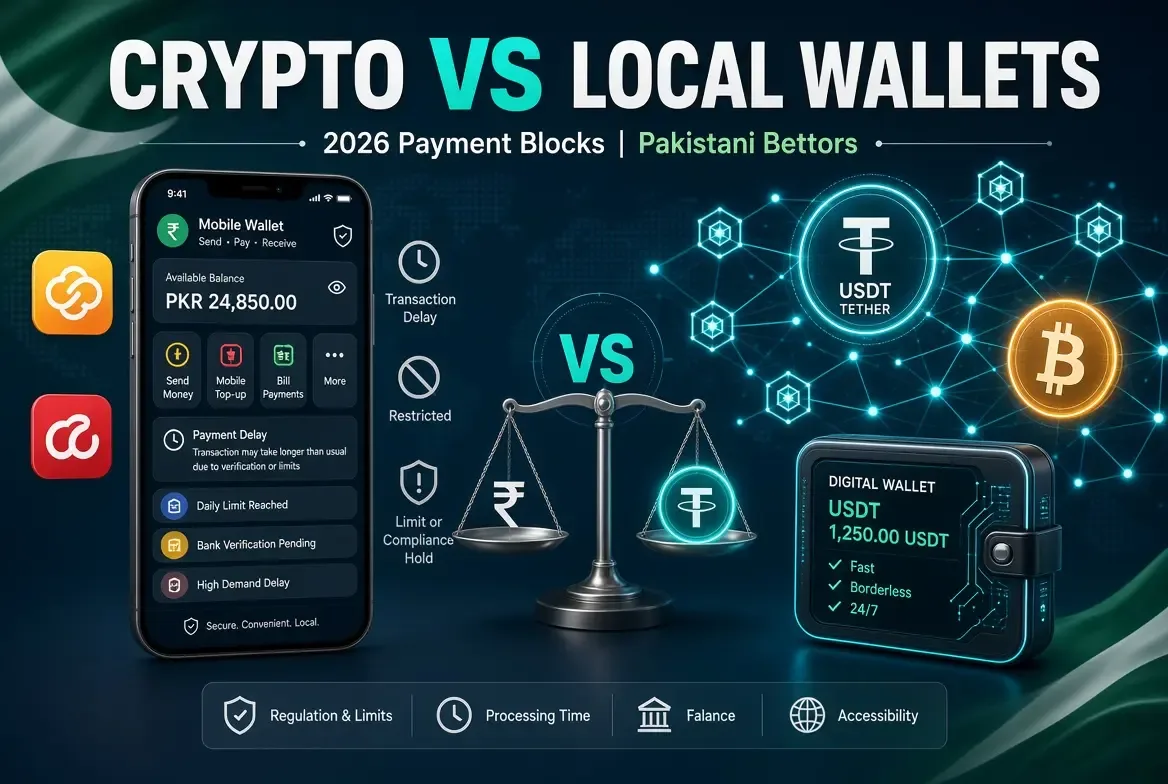
In October 2026, conversations among Pakistani players about deposit and withdrawal options intensified. Public reports detailed Federal Investigation Agency (FIA) scrutiny of digital payment channels linked to large-scale online gambling and related financial flows. JazzCash closed more than 100 aggregator accounts following agency directives, while Easypaisa-linked merchant and intermediary transactions faced delays and settlement issues across several payment firms. Ordinary peer-to-peer tran
This article compares local mobile wallets with cryptocurrency payments in the practical scenarios Pakistani players encounter. It stays neutral: neither method is presented as superior or recommended for any specific use. The goal is clearer understanding of speed, limits, anonymity realities, volatility, irreversibility, shared legal constraints, and common fund-security oversights. Online gambling remains illegal under Pakistani law. Nothing here encourages illegal activity. Both payment routes operate under the same overarching legal framework.
Local Wallets Status: JazzCash and Easypaisa Recent Issues
JazzCash and Easypaisa dominate everyday digital payments in Pakistan. They handle bill payments, mobile top-ups, person-to-person transfers, and merchant collections under State Bank of Pakistan oversight. For years they also appeared in discussions of deposits and withdrawals connected to offshore platforms.
In early October 2026, that landscape shifted visibly. Reports indicated JazzCash shut more than 100 aggregator accounts after FIA notices; some accounts of the total affected exceeded that figure through internal review. Aggregator accounts process higher volumes for intermediaries and merchants. Their closure affected settlement flows tied to those channels.
Around the same period, Easypaisa-linked transactions experienced processing delays and settlement problems involving firms including SWICH, Simpaisa, ajarPay, RapidPay, Zero Technologies and Finza Tech. International processor dLocal also reported related issues under investigation. Routine wallet services and person-to-person transfers continued operating.
These actions formed part of a broader FIA probe. Investigators examined transactions totaling approximately Rs 119.93 billion linked to alleged online gambling platforms and digital hundi-hawala patterns. Funds moved through bank accounts, mobile wallets and cryptocurrency channels, including USDT. Separate findings noted billions flowing through a small number of branchless banking collection accounts across millions of transactions. The Pakistan Telecommunication Authority also blocked related applications.
Personal wallet holders were not the primary targets. Reports emphasized that ordinary accounts for everyday use remained functional. The pressure concentrated on aggregator, merchant and intermediary pathways that authorities associated with suspicious high-volume activity. Still, the visible delays and account actions raised practical questions for anyone whose deposit or withdrawal route depended on those intermediary layers.
Players already familiar with name-matching requirements, monthly limits by KYC tier, and occasional manual reviews found the new friction layer significant. Withdrawals that previously cleared in minutes or hours could face extended holds when intermediary channels were under review. This public background—documented across multiple local tech and news outlets—explains why alternative payment discussions gained traction in late 2026.
Cryptocurrency Payments: Practical Advantages and Drawbacks
Cryptocurrency payments, most commonly stablecoins such as USDT in local discussions, offer a different set of characteristics. Transfers on major blockchains can settle in minutes once initiated. Network fees vary but are often modest relative to larger amounts. There is no direct equivalent of a daily or monthly wallet tier limit imposed by a single Pakistani provider; constraints instead come from exchange or peer-to-peer (P2P) platforms, liquidity, and the user’s own verification status.
Speed is not uniform. On-chain confirmation can be fast. Converting between PKR and crypto usually requires a P2P trade or an on-ramp. Those steps introduce counterparties, payment confirmation waits, and potential disputes. What looks near-instant in ideal conditions can stretch when liquidity is thin or when a counterparty delays release.
Limits are more flexible in theory. Users can move larger sums than basic JazzCash or Easypaisa tiers allow, provided they find matching liquidity and complete any required verification on the platforms they use. In practice, new or lightly verified accounts often face smaller trade sizes.
Two structural drawbacks stand out. First, price volatility. Even stablecoins can trade at slight premiums or discounts to the dollar in local P2P markets; non-stable assets fluctuate more sharply. A player converting PKR to crypto, waiting, then converting back can lose or gain on the exchange rate alone. Second, irreversibility. Once a blockchain transaction is confirmed, it cannot be reversed by a customer-service call or chargeback process of the kind available with regulated wallets under State Bank rules. Mistakes, phishing, or sending to the wrong address result in permanent loss.
Anonymity is frequently overstated. On-chain activity is publicly visible and permanently recorded. Major exchanges and many P2P platforms require identity verification. Pakistani authorities have examined cryptocurrency channels in the same investigations that touched mobile wallets. Relative privacy exists compared with a fully KYC-linked mobile wallet transaction that carries a clear name and CNIC trail, yet absolute anonymity does not.
Side-by-Side Comparison of Real Use Scenarios
The following table summarises typical experiences reported in player discussions and public payment behaviour as of late 2026. Figures are approximate and vary by user tier, platform, time of day and market conditions.
| Factor |
JazzCash / Easypaisa (local wallets) |
Cryptocurrency (typical stablecoin route) |
| Deposit speed |
Often minutes when direct; longer if intermediary review |
Minutes on-chain after P2P or on-ramp completion |
| Withdrawal speed |
Minutes to hours normally; extended during 2026 scrutiny |
Minutes on-chain; P2P release can take longer |
| Practical limits |
Tier-based (basic to higher KYC); monthly caps common |
Platform/liquidity dependent; fewer hard monthly caps |
| Fees |
Low or zero for many peer and merchant payments |
Network fees + possible P2P spread |
| Name / identity match |
Strict CNIC and name alignment required |
Varies; many platforms still require KYC |
| Reversibility |
Possible complaint and recovery routes under SBP rules |
Generally irreversible once confirmed |
| Volatility exposure |
None (PKR fixed) |
Present (even stablecoins can show local premiums) |
| Traceability |
High – linked to CNIC and mobile number |
On-chain public; exchange KYC adds identity layer |
| Dependency on local rails |
High – subject to aggregator and FIA-related actions |
Lower direct dependency, but PKR on/off ramps still local |
Local wallets remain simplest for small, routine amounts when channels function normally. Crypto routes reduce reliance on the specific aggregator layers that faced closures and delays in October 2026, at the cost of added conversion steps and irreversible finality.
Risk Comparison Across Legal, Financial and Operational Dimensions
Legal constraints are shared. Online gambling is prohibited under the Prevention of Gambling Act 1977 and related provincial rules. Sending funds for that purpose, regardless of rail, sits outside approved foreign-exchange and payment-system uses. The same FIA investigations that examined mobile-wallet flows also reviewed cryptocurrency channels, including USDT movements. Pakistan’s Virtual Assets Act 2026 established a regulatory framework for virtual asset service providers; activity remains subject to law enforcement and regulatory oversight. Using either method does not create a legal safe harbour.
Fund risks differ in character. With local wallets, the main recent risks have been delayed settlement, temporary holds during reviews, and the possibility of aggregator channels being closed. Regulated providers operate under State Bank complaint timelines and, in some cases, consumer-court precedents for unauthorised transfers. With crypto, the dominant risks are volatility during the holding period, irreversible loss from address errors or phishing, and counterparty risk in P2P trades. There is no central customer-service desk that can reverse a confirmed blockchain transfer.
Operational risks include user behaviour. Players frequently overlook basic security. Sharing CNIC details, OTPs or wallet access with third parties to “facilitate” deposits or withdrawals creates exposure on both rails. Using someone else’s wallet or account risks rejection at payout stage and potential account flags. Leaving large balances on any platform—wallet or exchange—concentrates risk. Ignoring name-matching rules on local wallets or sending crypto without double-checking the address produces the same outcome: stalled or lost funds.
A further common oversight is treating payment method choice as the primary risk variable while under-weighting platform reliability, bonus wagering conditions, and the absence of local regulatory recourse for offshore operators. Payment friction is only one part of the overall exposure.
Neutral Summary: Trade-offs, Not Perfect Solutions
The 2026 payment-block environment—driven by FIA scrutiny of aggregator accounts, merchant settlement delays on Easypaisa-linked channels, and associated investigations into roughly Rs 120 billion in flows—has made reliability of traditional local-wallet routes less predictable for certain use cases. Crypto payments offer an alternative pathway with different speed and limit characteristics, yet introduce volatility, irreversibility and their own conversion frictions.
Neither option eliminates legal exposure. Both remain subject to Pakistani law. Neither guarantees fund recovery when things go wrong. Local wallets provide regulated complaint channels but proved vulnerable to intermediary-level disruption. Crypto reduces dependence on those specific intermediaries while removing the safety net of reversible transactions and exposing users to market and operational risks that many underestimate.
Players evaluating options in this environment benefit from focusing on verifiable facts rather than promotional claims: current processing behaviour of the channels they actually use, personal risk tolerance for irreversible transfers, understanding of on-chain and KYC traceability, and the shared legal reality that applies irrespective of payment rail. No method removes the fundamental constraints. The practical decision is one of risk weighting, not of finding an unconstrained solution.
This comparison is observational only. It does not recommend any payment method, platform or activity. Readers should treat all financial decisions with independent caution and remain aware that engagement with prohibited online gambling carries legal and financial consequences under Pakistani law.