Teen Patti Starting with 100 Rs: The 5 Key Decisions for Small-Bankroll Players
GamePK Editor · · 3 views

Starting Teen Patti with just 100 Rs? Discover 5 practical, risk-managed decisions covering micro-stakes, blind vs. seen play, disciplined folding, strict stop-loss limits, and realistic withdrawal habits. Designed for small-bankroll players to protect funds, avoid emotional tilt, and maintain responsible control.
Teen Patti is one of the most popular three-card games across South Asia. For players in Pakistan starting with a modest bankroll of around 100 Rs on online card gaming apps, the experience can be entertaining, but it is also full of financial risks.
Let us clear up the most important myth right away: there is no secret system, formula, or trick that guarantees stable profits or successful withdrawals in Teen Patti. Every hand is subject to statistical house edges and random variance. The goal of this guide is not to teach you how to "win big," but rather to break down five critical decision-making points that can help you manage a micro-bankroll effectively, lower your risk of going broke quickly, and maintain control over your gaming experience.
A Quick Refresher: Teen Patti Core Mechanics
If you are new to online Teen Patti, the fundamentals are straightforward:
- The Deal: Each player is dealt three cards face down.
- Blind vs. Seen (Chaala): You can play as a Blind player (betting without looking at your cards) or as a Seen player (looking at your cards first). Seen players must bet double the current Blind bet amount to stay in the hand.
- Actions: On your turn, you can Call (match the current bet), Raise (increase the bet), or Fold (forfeit your hand and any money already put into the pot).
- Showdown (Sideshow/Show): When only two players remain, one can request a "Show" to compare hands. The higher-ranking hand (from High Card up to Trio/Trail) wins the pot.
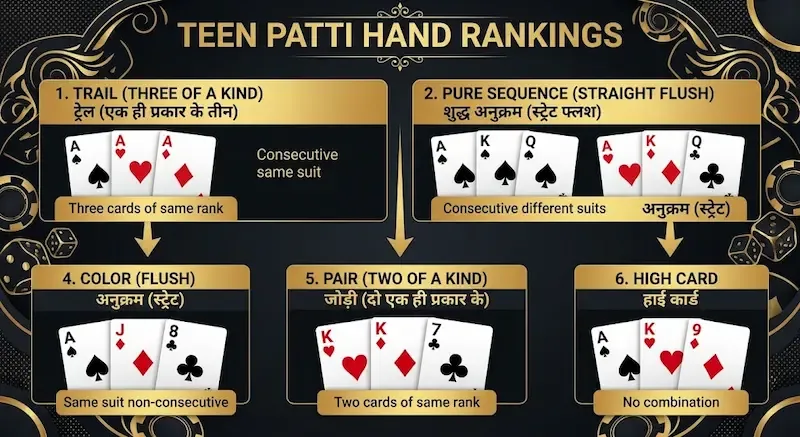
Decision 1: Controlling Your Per-Hand Stake
When entering a table with only 100 Rs, your single biggest decision happens before the cards are even dealt: choosing the right table stakes.
- The Practical Standard: Ideally, your minimum boot amount (the entry fee per hand) should be no more than 1 Rs to 2 Rs. This gives you a buffer of 50 to 100 hands.
- Pros: Keeping stakes low ensures that a bad streak of 5 or 10 cold hands does not wipe out your total balance in ten minutes.
- Cons: Wins feel small. For players seeking quick adrenaline, low-stake play can feel slow.
- The Reality: Jumping straight onto a table with a 10 Rs or 20 Rs boot amount with a 100 Rs bankroll means 3 or 4 bad hands will completely bust your balance. Tight stake management does not increase your odds of winning individual hands, but it slows down bankroll depletion.
Decision 2: When to Stay Blind vs. When to Look at Cards
Playing Blind is a core mechanic of Teen Patti, but for small-bankroll players, it double-edged.
Playing Blind (First 1–2 Rounds):
- Pros: You pay half the bet amount compared to Seen players. This allows you to stay in the pot cheaply while other players potentially fold weak hands.
- Cons: You are betting blind money on a completely random hand.
Looking at Your Cards (Seen):
- Pros: Gives you full information to decide whether your hand is worth continuing.
- Cons: Every action costs double the Blind rate.
The Strategy: With 100 Rs, limit blind betting to a maximum of 1 or 2 turns at minimum stakes. If the pot size escalates rapidly due to aggressive raises from other players, check your cards immediately. Continuing to bet blind into a heavily raised pot rapidly eats away at small balances.
Decision 3: Knowing When to Fold vs. When to Raise
The inability to fold weak or marginal hands is the primary reason small bankrolls disappear quickly.

When to Fold:
- Fold instantly on low High-Card hands (e.g., J-7-3) or weak unmatched cards after viewing them.
- Fold when facing a massive raise from a player with a larger chip stack if you only hold a low Pair or weak Flush.
- Pros of Folding: Saves remaining balance for future hands; reduces decision fatigue.
- Cons: You forfeit the small ante/boot already paid.
When to Raise:
- Raise primarily when you hold strong value hands (such as a high Pair, Straight, Flush, or Trio) and want to charge opponent hands to see a showdown.
- Pros: Capitalizes on hands where you hold a genuine statistical advantage.
- Cons: Raises can backfire if an opponent holds an even higher combination.
The Reality: Bluffing or over-raising on small bankrolls rarely works well online because opponents often call liberally at low stakes. Stick to folding weak hands early.
Decision 4: Setting Daily Stop-Loss and Stop-Profit Limits
A strict discipline structure is essential whenever real money is involved.
Setting a Stop-Loss:
- Decide in advance how much of your 100 Rs you are willing to lose in a single session. For example, if you lose 50 Rs, close the app for the day.
- Pros: Prevents emotional "chasing" of losses, which usually results in losing the remaining 50 Rs.
Setting a Stop-Profit (Take-Profit):
- Set a realistic upper target. If your 100 Rs reaches 150 Rs or 180 Rs, consider stopping.
- Pros: Locks in small gains before market variance inevitably pulls your balance back down.
- Cons: Requires strong self-control to walk away while on a winning run.
Decision 5: Timing Withdrawals and Mindset Management
Many players occasionally double their small balance, only to play until they lose every rupee back. Managing your cash-outs is just as critical as playing the hands.
When and How Much to Withdraw:
- If app minimum withdrawal thresholds permit, cash out any profit above your initial 100 Rs deposit immediately.
- Alternatively, withdraw your initial 100 Rs seed capital once you reach a safe buffer, leaving only non-critical winnings to play with.
Mindset & Avoiding "Tilt":
- Never view online card games as an income stream or investment.
- Realize that winning 50 Rs on a 100 Rs balance is largely the result of short-term luck, not long-term skill.
- If you feel frustrated after a bad beat or feel compelled to redeposit immediately, step away.
Long-Term Realities of Online Gambling
It is crucial to understand the mathematical reality of card games played on digital platforms:
- House Edge & Platform Fees: Online platforms deduct commission (rake) from winning pots. Over hundreds of hands, this fee steadily erodes player balances.
- Negative Expectation: Mathematically, the average player will lose money over time. Any story of turning 100 Rs into consistent daily income is either an outlier caused by short-term statistical variance or marketing exaggeration.
- No Guarantees: Implementing bankroll management rules only reduces the speed at which you lose money during bad runs—it does not alter the underlying odds of the game.
Responsible Gaming Summary
Card games like Teen Patti should strictly be viewed as paid entertainment, similar to buying a movie ticket—never as a way to earn money or solve financial problems.
- Important Risk Warning:Gambling involves significant financial risk and can be addictive. Please participate responsibly and strictly within your financial means. If you cannot afford to lose the money, do not play. If you happen to win, withdraw your funds promptly and avoid the temptation to continuously re-wager your balance. Stay in control, set strict boundaries, and know when to stop.