Why Your JazzCash or Easypaisa Withdrawal Failed in 2026: CNIC Mismatch, Limits & FIA Fallout Explained
GamePK Editor · · 1 views
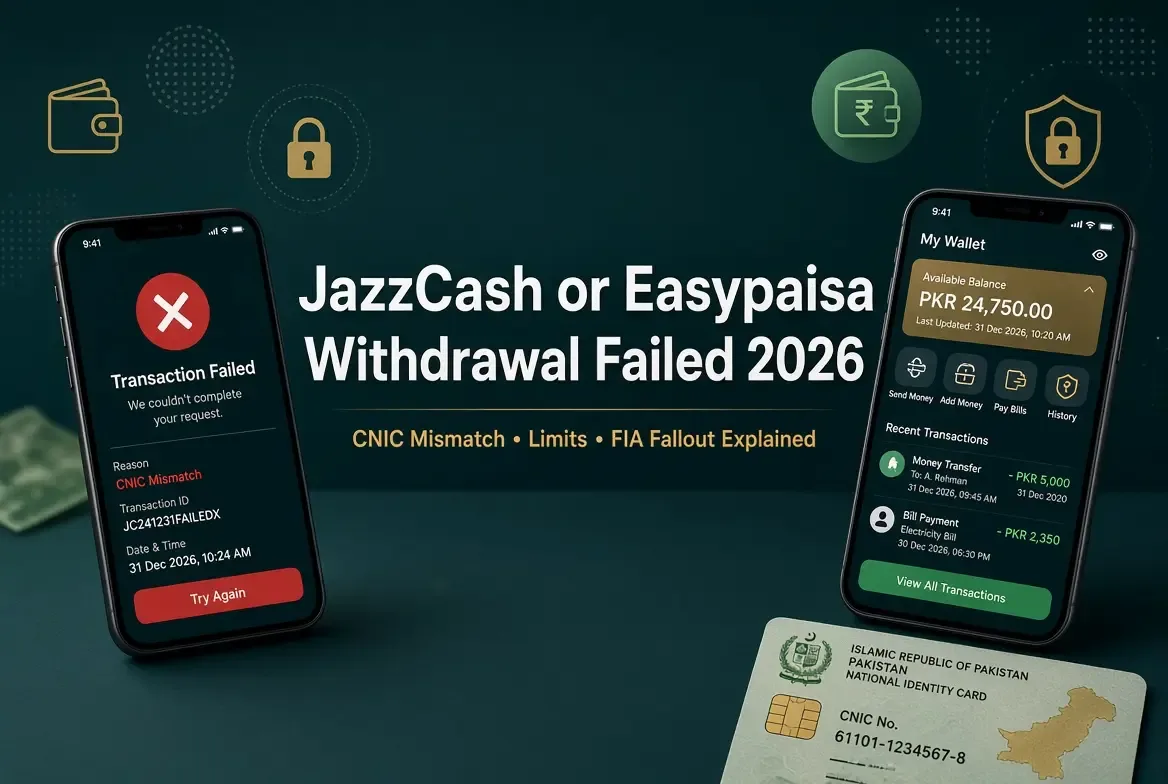
In 2026, failed JazzCash and Easypaisa withdrawals have become one of the most frequent complaints among Pakistani mobile wallet users. Money appears to leave an app or platform, yet nothing arrives in the wallet. Transaction status stays pending, returns with a vague error, or simply never shows up. For ordinary users the result is the same: funds feel stuck, support chats go in circles, and anxiety rises.
This guide focuses on the technical and compliance reasons that cause most failures. It explains name and CNIC matching rules, monthly limits, dormant account behaviour, and the indirect effects of recent Federal Investigation Agency (FIA) actions on aggregator and intermediary channels. The goal is practical self-diagnosis so you can understand what went wrong. It does not offer workarounds, recovery methods for restricted accounts, or advice on continuing restricted activit.
Most Common Failure Cases Users Report
Users typically encounter one of these patterns:
- The withdrawal is rejected almost immediately with a name or account title error.
- The amount exceeds the wallet’s daily or monthly limit and is declined.
- The wallet has become dormant through lack of use and stops accepting incoming transfers.
- Transfers that previously worked suddenly fail or remain pending for days, especially when routed through certain merchant or aggregator channels.
These issues are not random. They stem from rules designed to meet State Bank of Pakistan branchless banking requirements and anti-money laundering (AML) controls.
Core Rule: Name Must Match CNIC Exactly
The single most frequent technical cause of failed JazzCash or Easypaisa withdrawals is a mismatch between the name on the sending side and the registered account title linked to the CNIC.
JazzCash and Easypaisa accounts are opened against a CNIC. The account title is taken from NADRA records. Payment gateways and automated checks compare the name provided in a withdrawal request against that registered title. Even small differences trigger rejection:
- Missing or extra middle names (“Ali Khan” versus “Muhammad Ali Khan”).
- Spelling variations or abbreviations.
- Use of a relative’s name or a nickname.
- Account opened on a SIM registered to someone else.
When the names do not match character-for-character, systems flag the transfer as a potential third-party movement. Larger amounts or transfers involving bank rails face stricter automated screening. The result is an immediate decline or an AML-style hold.
This requirement exists because wallets are treated as personal financial accounts. Third-party deposits raise compliance concerns under existing AML rules. Checking the exact name shown in your JazzCash or Easypaisa app profile against the CNIC is therefore the first diagnostic step.
Monthly Limits and Account Status Rules
Every JazzCash and Easypaisa account operates under transaction limits set by account level (KYC tier). Limits apply to both sending and receiving.
Basic (often called Level 0 or non-biometric) accounts typically allow lower daily and monthly volumes. Common published figures for lower tiers include daily limits around Rs 25,000 and monthly limits around Rs 50,000, with corresponding annual caps. Biometric verification raises these ceilings substantially (daily figures of Rs 50,000 or higher and monthly figures of Rs 200,000 or more, depending on the exact tier and provider schedule). Higher tiers exist for verified digital or business accounts.
When a withdrawal exceeds the available limit for the day or month, the transfer fails even if the balance is sufficient. Limits reset according to the calendar cycle of the wallet provider. Users can usually view remaining limits inside the app under account or transaction settings.
Account dormancy is another frequent trigger. Easypaisa marks an account dormant after approximately 90 days without activity. JazzCash applies a longer inactivity period, commonly 12 months. A dormant wallet may reject incoming transfers until it is reactivated through the provider’s standard process (usually a small deposit or a verified call from the registered number). Dormancy is a security measure, not a penalty, but it stops money from arriving until the status is restored.
Additional temporary blocks can appear after a new device login, MPIN change, or SIM-related event. These are short security holds required under State Bank rules.
FIA Actions and Indirect Effects on Ordinary Users
In September and October 2026 the FIA intensified investigations into online gambling platforms and associated digital payment flows. Public reports indicated that authorities traced large volumes of transactions linked to suspected illegal activity, including movements through branchless banking collection accounts.
Following FIA directives, JazzCash closed more than 100 aggregator accounts. Similar settlement and processing disruptions affected certain Easypaisa merchant and intermediary channels. Ordinary person-to-person transfers and standard wallet functions continued to operate for most users. However, platforms that relied on the closed or delayed aggregator and intermediary routes experienced higher rates of pending or failed withdrawals.
For individual users the practical effect is indirect. Withdrawals that previously cleared quickly through certain payment partners may now remain pending longer, reverse, or fail without a clear wallet-side error. The underlying personal account is usually unaffected; the problem sits in the intermediary layer that the sending platform uses. This distinction matters: a failed withdrawal does not automatically mean the user’s own JazzCash or Easypaisa account has been restricted.
These actions form part of broader AML enforcement. Using mobile wallets to move funds connected to prohibited activities carries legal and financial risk for the account holder.
Practical Self-Check Checklist (Technical Layer Only)
Before contacting support, run these basic checks:
- Open the JazzCash or Easypaisa app and note the exact registered account title. Compare it character-for-character with the name used on the sending platform and with the CNIC.
- Confirm the mobile number is registered in your own name. Send your CNIC to 668 or use the PTA SIM Information System to verify ownership.
- Check remaining daily and monthly limits inside the wallet app. Note whether the attempted amount exceeds the available ceiling.
- Review recent activity. If the wallet has been idle for weeks or months, test whether a small incoming transfer is accepted.
- Look at the transaction status and any reference or transaction ID provided by the sending side. Note the exact time and amount.
- Confirm biometric verification status if the account is still on a basic tier.
- Check whether a recent device change, MPIN update, or SIM event occurred, as these can impose temporary debit or credit holds.
These steps identify the most common technical causes. They do not constitute instructions for altering account status beyond normal provider processes or for routing funds around limits.
Risk and Compliance Reminders
Using JazzCash or Easypaisa accounts for gambling-related transactions can violate anti-money laundering regulations. Pakistani authorities have actively investigated such flows. Account holders may face enforcement action, account restrictions, or other legal consequences. Funds associated with prohibited activity are at elevated risk of being held or lost.
When money appears stuck, the most overlooked risk is continued interaction with the same sending platform while the underlying compliance issue remains unresolved. Repeated failed attempts can compound scrutiny. Ordinary users should treat the wallet as a personal financial tool subject to standard banking rules rather than a channel for high-risk activity.
This article explains technical and regulatory reasons only. It does not provide methods to bypass limits, restore restricted accounts for continued high-risk use, or recommend alternative channels for prohibited purposes. No absolute guarantees are offered about recovery of any specific transaction.
Summary and Rational Next Steps
JazzCash and Easypaisa withdrawal failures in 2026 most often result from exact name/CNIC mismatches, exceeded account-level limits, dormant status, or disruptions in intermediary payment channels following FIA actions against aggregator accounts linked to high-risk activity. Ordinary peer-to-peer functionality has largely continued, but platforms dependent on affected routes have seen higher failure rates.
Users benefit from methodical self-checks focused on the registered name, limits, and account activity status. Understanding these rules reduces unnecessary anxiety and helps distinguish wallet-side problems from platform-side or intermediary issues.
Maintain the wallet in compliance with its terms. Verify identity details carefully at the outset. Treat limits and dormancy rules as fixed operational constraints rather than obstacles to be circumvented. When funds are involved in activities that may attract regulatory attention, the safest course is to stop and seek clarification through official channels rather than escalate risk.
Short FAQ
Why does the name have to match the CNIC so strictly?
Payment systems treat the wallet as a personal account tied to NADRA identity data. Mismatches are flagged as potential third-party transfers under AML controls.
What happens when I hit the monthly limit?
Further incoming or outgoing transfers of that type are declined until the limit resets or the account tier is upgraded through the provider’s normal biometric process.
Did the FIA actions freeze ordinary user accounts?
Public reports indicate the closures targeted aggregator and intermediary accounts. Standard personal wallet services continued for most users, though some withdrawal routes experienced delays.
Is there any way around these rules?
This article does not describe or endorse methods to circumvent limits, name matching, or compliance holds. Attempting to do so increases legal and financial risk.
Stay informed through official JazzCash and Easypaisa channels and the State Bank of Pakistan. Accurate diagnosis of the technical cause is the most reliable first response to a failed withdrawal.